The Untold Story of NASA’s First ISS Medical Evacuation: What the Mike Fincke Incident Really Means for Future Space Missions
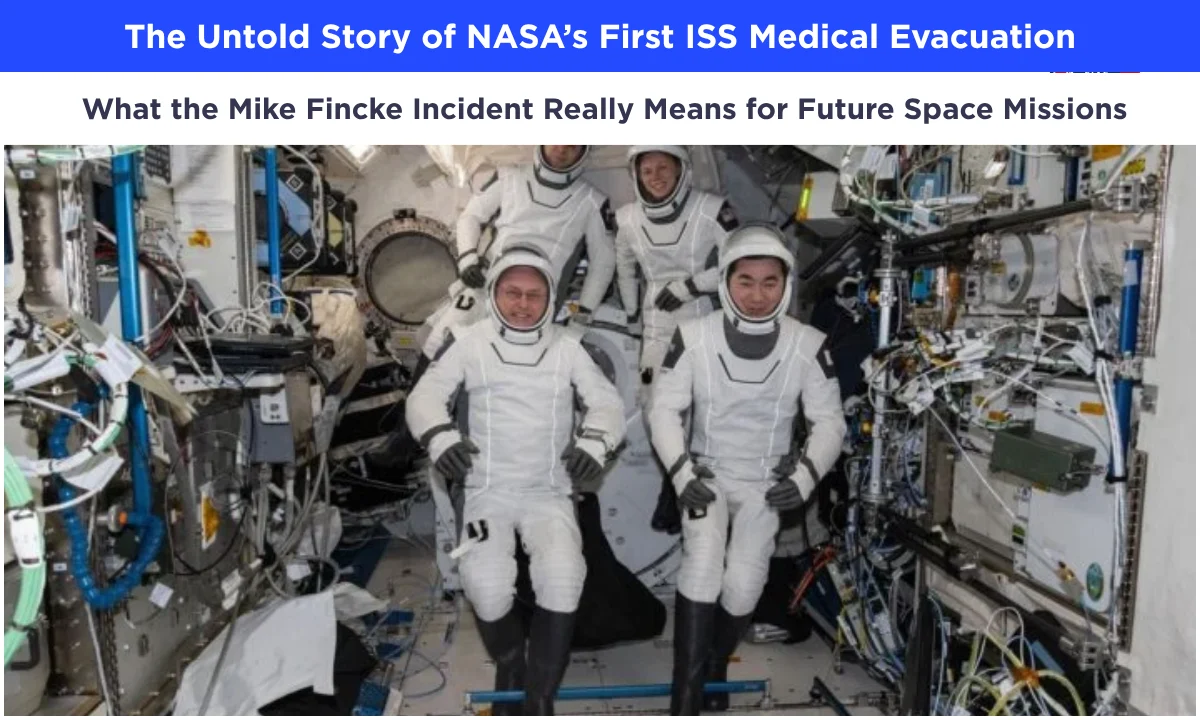
The Untold Story of NASA’s First ISS Medical Evacuation: What the Mike Fincke Incident Really Means for Future Space Missions
Space missions always look perfect from the outside. Everything seems planned and controlled. But the reality is very different. The recent NASA astronaut space station evacuation has shown that even the most advanced missions can face unexpected situations.
In January 2026, something happened on the International Space Station that had never happened before. A sudden medical issue forced NASA to bring astronauts back to Earth earlier than planned.
This incident quickly became a major topic across the internet. It gained even more attention after astronaut Mike Fincke shared details about what actually happened. Many people started asking important questions. How safe is space travel? What happens when a medical emergency occurs in space? And most importantly, are we truly ready for long missions like Mars?
In this article, you will get a complete and detailed understanding of the event. You will learn what exactly happened, why NASA took such a decision, the medical mystery behind it, and what it means for the future of human space exploration.
Key Takeaways NASA’s First ISS Medical Evacuation
- This was the first medical evacuation in ISS and human spaceflight history.
- Astronaut Mike Fincke lost his ability to speak for around 20 minutes without warning.
- NASA decided on a controlled early return instead of taking risks in space.
- The exact medical cause is still unknown even after detailed tests.
- This incident highlights major challenges for future Moon and Mars missions.
Table of Contents
What Actually Happened Onboard the ISS?
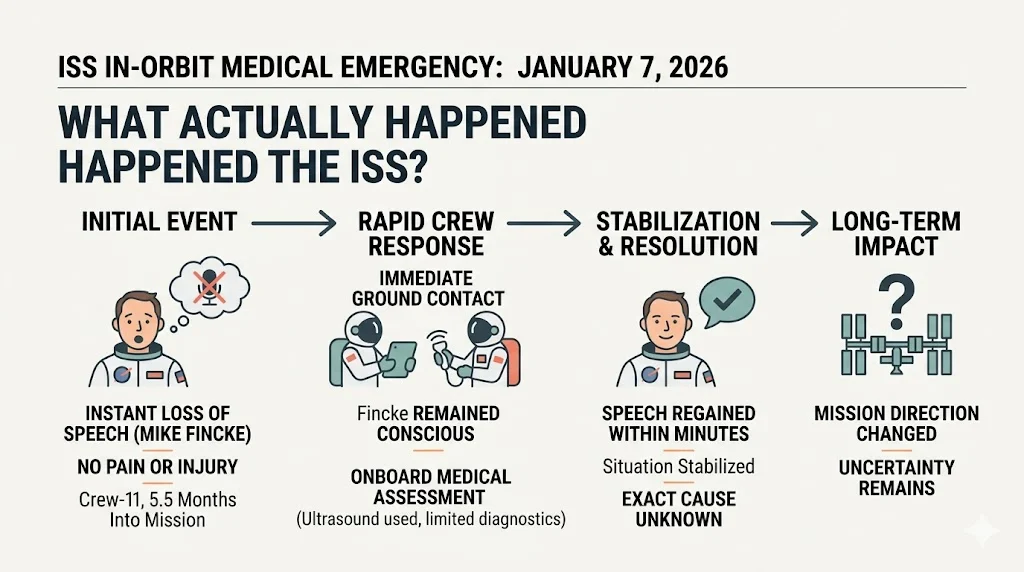
The incident took place on January 7, 2026. Crew-11 astronauts were about five and a half months into their mission. It was a normal day on the ISS. The team was preparing for an upcoming spacewalk. Everything was going as planned.
During dinner, Mike Fincke suddenly experienced something unusual. He lost his ability to speak. There was no pain. There was no injury. It happened instantly like a lightning strike. One moment he was fine. The next moment he could not talk.
The situation was serious. The crew quickly understood that something was wrong. They immediately contacted NASA’s ground control team. Communication stayed active. Fincke remained conscious throughout the event. This was a very important factor.
The crew used onboard medical tools like ultrasound to check his condition. These tools are helpful but limited. They cannot provide full diagnosis like machines on Earth. Within minutes, the situation was stabilized. Fincke slowly regained his speech. But the uncertainty remained. Nobody knew what exactly caused the issue. This single moment changed the direction of the entire mission.
Why NASA Chose a Controlled Evacuation
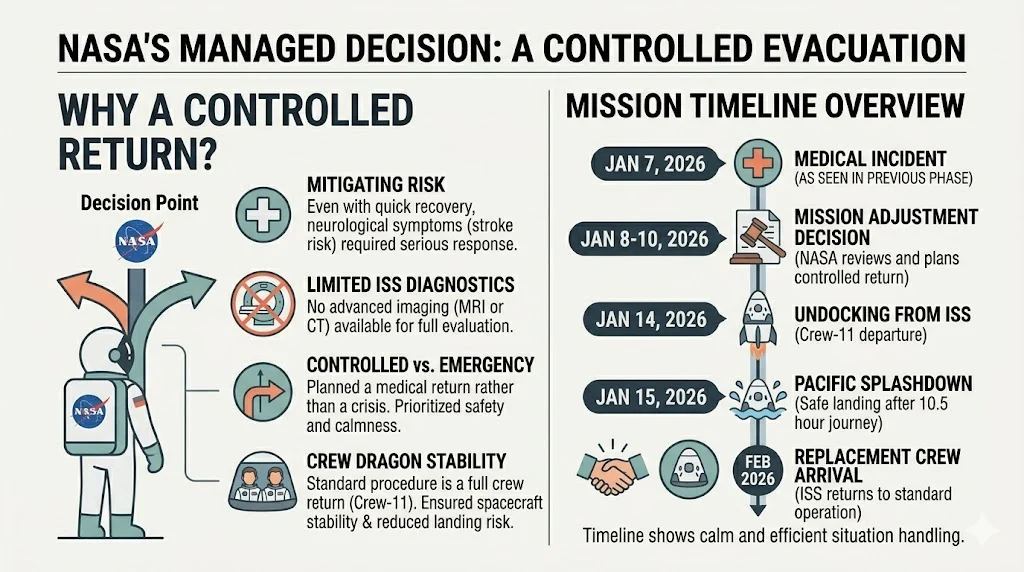
After the incident, NASA had to make a critical decision. On Earth, sudden loss of speech is often linked to serious conditions like stroke. Even though Fincke recovered quickly, the risk could not be ignored.
The International Space Station has limited medical capabilities. It does not have advanced imaging systems like MRI or CT scan. This makes it difficult to fully understand complex neurological issues.
NASA decided not to take any chances. Instead of treating it as an emergency evacuation, they planned a controlled medical return. This approach ensured safety without panic. The entire Crew-11 returned together. This is standard procedure for spacecraft operations. It ensures stability and reduces risk during return.
The astronauts boarded the SpaceX Crew Dragon capsule. The return journey took around ten and a half hours. They safely splashed down in the Pacific Ocean on January 15, 2026. After landing, Fincke was transported to a hospital for detailed medical evaluation.
Mission Timeline Overview
| Event | Date |
|---|---|
| Medical incident | January 7, 2026 |
| Mission adjustment decision | January 8–10, 2026 |
| Undocking from ISS | January 14, 2026 |
| Splashdown | January 15, 2026 |
| Replacement crew arrival | February 2026 |
This timeline shows how calmly and efficiently NASA handled the situation.
The Medical Mystery That Still Has No Answer
Even after returning to Earth, doctors could not find a clear cause. Multiple tests were conducted. Advanced imaging and full medical evaluations were done. Serious conditions like heart attack and choking were ruled out. There were no clear signs of stroke. This made the situation even more confusing.
As of now, the exact cause remains unknown. This uncertainty has made the incident more important. It has opened new discussions in space medicine. Scientists are now studying whether long exposure to microgravity affects the brain in unexpected ways.
There are some possible explanations being explored. These include fluid shifts toward the brain, changes in blood flow, and structural changes in the brain during long missions.
NASA is also reviewing past astronaut records. They want to find if similar cases happened before but were not fully understood. This case has exposed a major gap in our knowledge.
Space Medicine Challenges You Must Understand
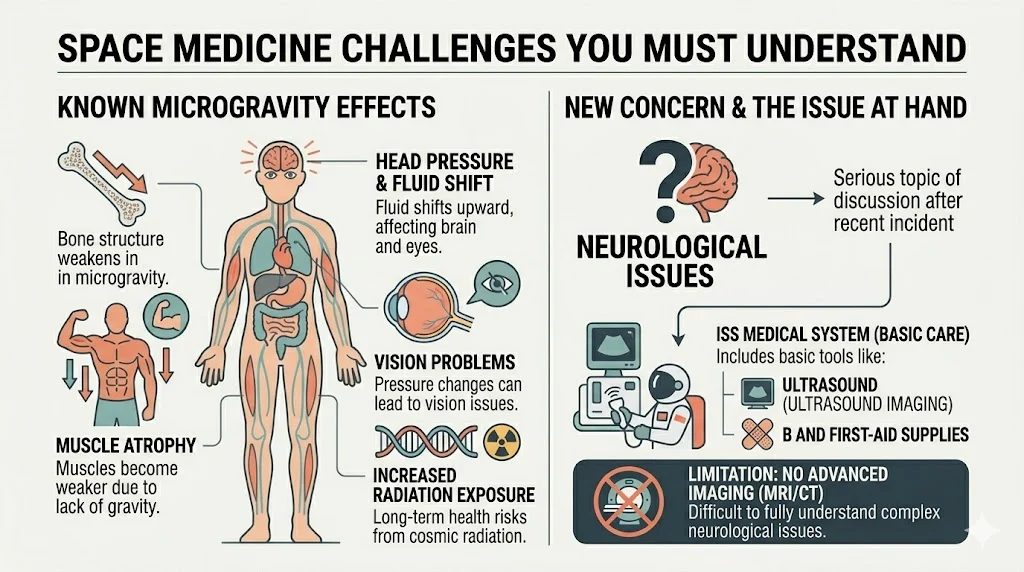
Living in space is very different from living on Earth. The human body behaves in unexpected ways in microgravity. Here are some known challenges astronauts face:
- Bone density decreases over time.
- Muscles become weaker due to lack of gravity.
- Vision problems develop because of pressure changes in the head.
- Body fluids shift upward, affecting the brain and eyes.
- Radiation exposure increases risk of long term health issues.
Now this incident has added another concern. Neurological issues are becoming a serious topic of discussion.
The ISS medical system is designed for basic care. It includes tools like ultrasound and basic medicines. But it cannot handle complex emergencies. This is a major limitation for future missions.
Crew Response and International Teamwork
One of the most impressive aspects of this incident was the crew response. The astronauts acted quickly and professionally, demonstrating the kind of discipline that comes only from years of rigorous training and simulation-based preparation. Every crew member knew their role and executed it without hesitation.
The ISS crew included members from different countries. Despite global tensions on Earth, teamwork in space remained strong. This highlights how international collaboration in space exploration goes beyond politics, focusing purely on mission success and human safety.
Everyone followed protocols. Communication with ground control was clear and continuous, ensuring that experts on Earth could guide the situation in real time. Decisions were made without panic, which is critical in high-risk environments where even small mistakes can have serious consequences.
The phrase “all hands on deck” perfectly describes the situation. Crew members assisted with medical checks, monitored Fincke’s condition, and ensured that all systems remained stable during the incident.
This shows that astronaut training, teamwork, and crisis management systems are extremely effective, even in unpredictable situations.
Operational Impact on the ISS
The early return of Crew-11 affected ISS operations. The station was left with a smaller crew for some time. This reduced the pace of scientific experiments and maintenance work. However, basic operations continued without major issues.
Critical systems such as life support, power management, and communication remained stable, as these are designed with redundancy and automation in mind. Astronauts onboard had to prioritize essential tasks over long-term research projects, temporarily delaying several ongoing experiments in biology, materials science, and Earth observation.
The reduced crew size also meant fewer hands for routine maintenance, which required careful scheduling and coordination with ground teams. Mission control played a key role in guiding astronauts through adjusted workflows to ensure safety and efficiency.
NASA quickly arranged a replacement crew. A new team arrived in February 2026. This restored normal operations on the ISS.
This quick response shows how flexible and prepared space agencies are, highlighting their ability to adapt to unexpected challenges without compromising mission integrity.
What This Means for Future Moon and Mars Missions
This incident is not just about one astronaut. It has much bigger implications. NASA is planning long missions under the Artemis program. Future missions to Mars will last for months or even years.
In such missions, immediate return to Earth will not be possible. If a similar medical event happens during a Mars mission, astronauts will have to manage it in space. This creates serious challenges.
Space agencies now need to focus on:
- Advanced medical equipment for spacecraft.
- Portable diagnostic tools for deep space missions.
- AI based health monitoring systems.
- Better training for astronauts in medical emergencies.
- Improved understanding of how space affects the brain.
This incident is acting as a warning signal. It is helping scientists prepare for future risks.
Public Reaction and Growing Curiosity
Social media played a major role in spreading this story. People across the world shared their opinions and concerns. Many praised NASA and the crew for their quick response. The calm handling of the situation impressed people.
At the same time, curiosity increased. People wanted to know what caused the issue. They also questioned how safe space travel really is. Some common reactions included:
- Space is still unpredictable.
- Astronauts deserve even more respect.
- Future missions need better safety systems.
Overall, the public response was positive but thoughtful.
The Human Side of the Story
One important aspect that many articles miss is the human side of this event. Behind every mission patch and technical report is a real person experiencing uncertainty in one of the most extreme environments known to humanity.
Mike Fincke has shared that he felt completely healthy before the incident. There were no warning signs, no discomfort, and no indication that something unusual was about to happen. Even after returning to Earth and undergoing extensive medical evaluations, he continues to feel normal. This makes the situation even more complex, as it highlights how unpredictable the human body can be in space.
He described the moment as surprising and somewhat disorienting. Imagine being fully conscious, aware of your surroundings, yet suddenly unable to communicate. In a place where communication is critical for safety, this can be deeply unsettling. Despite this, Fincke remained calm, relying on his training and the support system around him. He also expressed deep appreciation for his fellow crew members and NASA’s ground team, who responded quickly and professionally.
Astronauts undergo years of rigorous physical and psychological training to prepare for extreme scenarios. They simulate emergencies, practice medical procedures, and learn to operate under pressure. However, no amount of training can fully prepare someone for an unknown medical condition that has no clear explanation.
This incident reminds us that space exploration is not just about advanced technology, rockets, or scientific discovery. It is also about human resilience, vulnerability, and limits. As we push further into deep space, understanding and supporting the human element will be just as important as engineering breakthroughs.
Lessons Learned from This Incident
This event has taught us several important lessons.
- Space missions need better medical systems.
- Human body behavior in space is still not fully understood.
- Quick decision making can prevent bigger problems.
- Teamwork is critical in emergency situations.
- Continuous research in space medicine is essential.
These lessons will shape future missions.
Final Thoughts
The NASA astronaut space station evacuation is more than just a news story. It is a turning point in space exploration.
On one side, it shows the risks of living in space. The human body can react in unexpected ways. There are still many unknowns.
On the other side, it shows the strength of modern space missions. The crew response was excellent. NASA handled the situation with precision and calmness.
In my opinion, this incident should not create fear. Instead, it should create awareness. Every mission teaches us something new. This event has given valuable insights into astronaut health and mission safety.
As we move toward Moon and Mars missions, such lessons will become even more important. Space is still full of mysteries. And understanding these mysteries is the key to safe and successful exploration.
Related Posts :





Share This Post