The Truth Behind “Spudnik-1”: How a Viral Space Potato Reveals the Future of Farming Beyond Earth
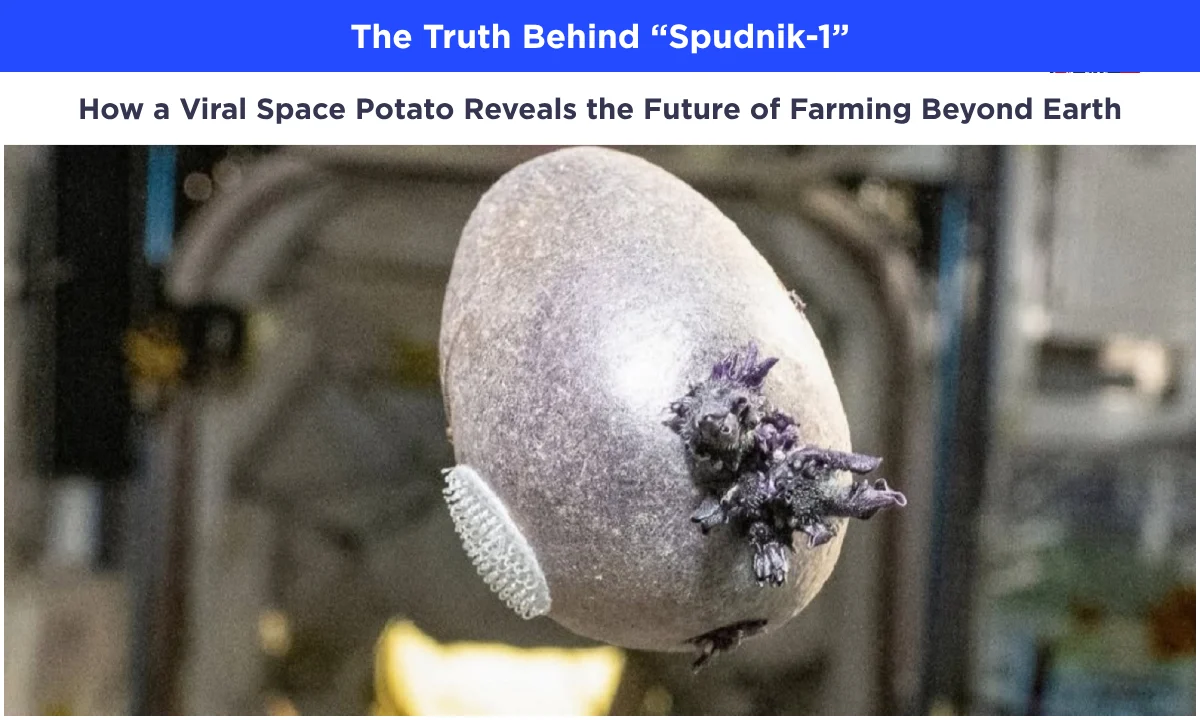
The Truth Behind “Spudnik-1”: How a Viral Space Potato Reveals the Future of Farming Beyond Earth | Image Via © www.ibtimes.co.uk
If you have spent any time online recently, you may have seen a strange purple object floating inside the International Space Station. Many people thought it was something from a science fiction movie. Some even believed it was an alien life form. The reality is far more fascinating and meaningful.
This viral moment is about a simple potato grown in space by Don Pettit. He named it “Spudnik-1” as a playful reference to the first satellite Sputnik. At first, the image shocked people because the potato had long, tentacle-like sprouts growing in every direction. But once the explanation came out, curiosity replaced fear.
This is not just a funny internet story. It is an important step in understanding how humans can grow food in space. It also gives us a glimpse into future missions to the Moon and Mars. Behind this unusual potato lies serious science, creativity, and the future of survival beyond Earth.
Key Takeaways
- Spudnik-1 is a purple potato grown aboard the International Space Station
- The experiment was conducted by astronaut Don Pettit during Expedition 72
- Microgravity causes plants to grow in unpredictable and unusual patterns
- Space farming will be essential for long-duration missions to the Moon and Mars
- The viral story helped make space science more relatable and engaging
Table of Contents
What Is the “Spudnik-1” Space Potato?
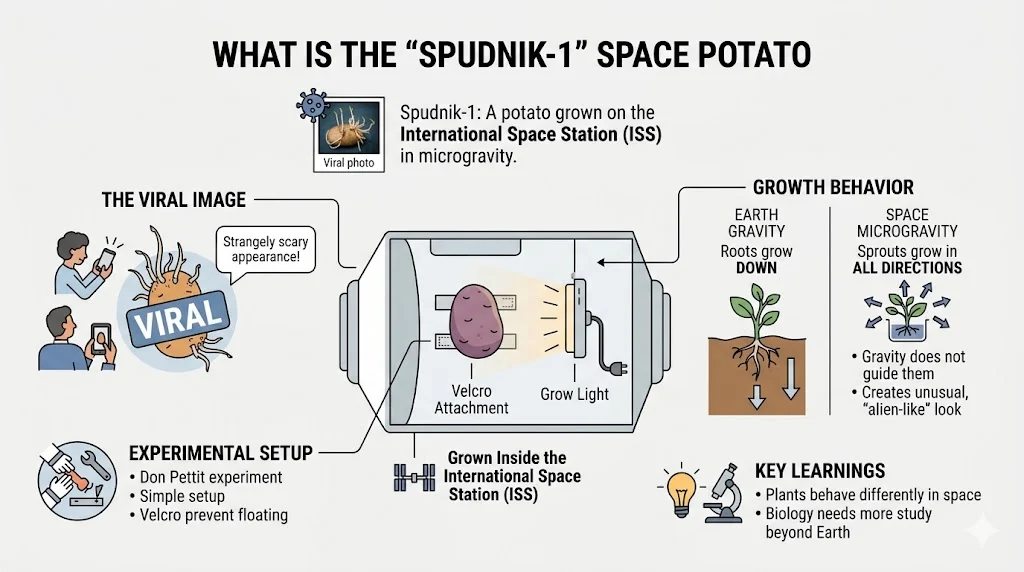
Let us begin with the most important question. What exactly is Spudnik-1? Spudnik-1 is a potato that was grown in microgravity inside the International Space Station. It became famous after an image of it went viral online. The potato had long sprouts that looked like tentacles. This gave it a strange and slightly scary appearance.
Don Pettit shared the image and explained the experiment. He described it as an early purple potato that he grew using a simple setup. The potato was attached using Velcro so it would not float away. A small grow light provided the energy needed for growth.
The most interesting part is how it grew. On Earth, roots grow downward due to gravity. But in space, there is no gravity to guide them. As a result, the sprouts grew in all directions. This created the unusual and alien-like look.
This experiment shows how even a simple plant behaves differently in space. It also highlights how much we still need to learn about biology beyond Earth.
Who Is Don Pettit and Why He Matters
To truly understand this story, you need to know the person behind it. Don Pettit is not just any astronaut. He is a chemical engineer and a veteran space explorer. He has spent many months in space across multiple missions. Even at an advanced age, he continues to explore and experiment with curiosity.
What makes him unique is his approach to science. He is known for conducting small personal experiments during his free time. These are often simple but deeply insightful. His work shows that science does not always need complex equipment. Sometimes, curiosity is enough.
He is also famous for his space photography. His images of Earth, stars, and space phenomena are widely admired. He has also invented tools like the zero-gravity cup, which allows astronauts to drink liquids more easily in space.
Spudnik-1 fits perfectly into his style. It is simple, creative, and meaningful. It connects science with everyday life. That is why people found it so interesting.
The Science Behind Spudnik-1
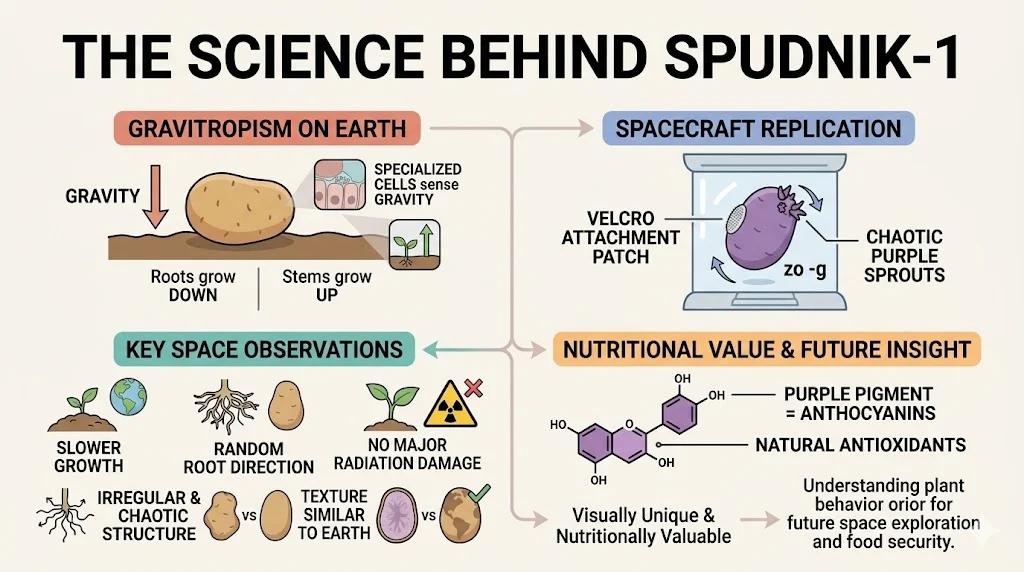
Now let us go deeper into the science. Plants on Earth rely on gravity to grow properly. This process is called gravitropism. Roots grow downward and stems grow upward. Specialized cells inside plants help them sense gravity.
In space, this system does not work the same way. Without gravity, plants lose their sense of direction. This is why the potato sprouts grew in random directions. There are several important observations from this experiment:
- Growth is slower compared to Earth
- Roots do not follow a fixed direction
- Structure becomes irregular and chaotic
- No major visible damage from radiation
- Texture remains similar to Earth-grown potatoes
The purple color of the potato comes from compounds called anthocyanins. These are natural pigments that also act as antioxidants. This makes the potato not only visually unique but also nutritionally valuable.
This experiment helps scientists understand how plants behave in space. It also provides clues on how to improve farming systems for future missions.
Why Growing Food in Space Is Important?
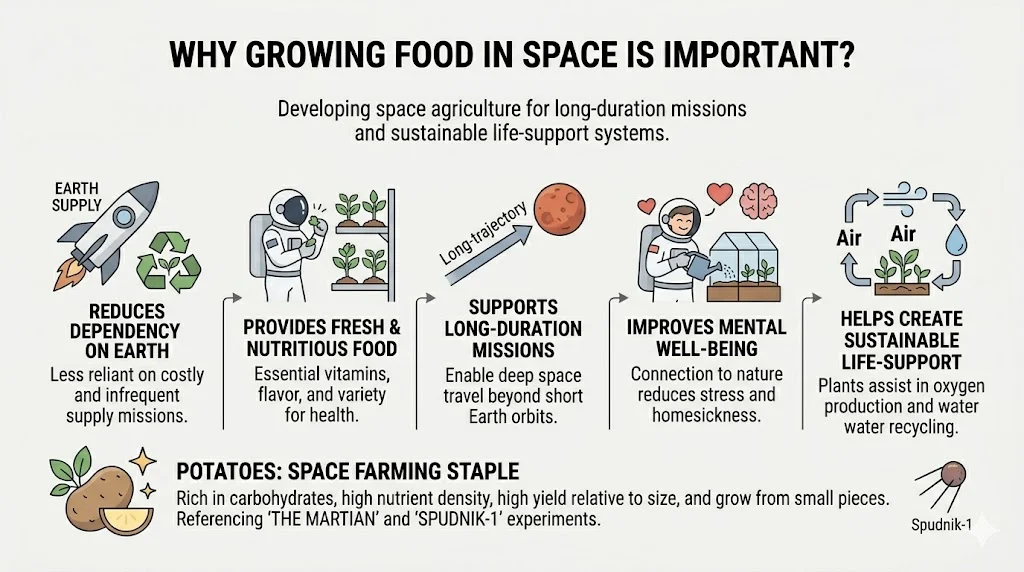
At first glance, this may look like a fun experiment. But it has serious implications. Astronauts currently depend on supply missions from Earth. Food is packed, preserved, and sent to space. This works for short missions. But it is not practical for long missions to Mars or beyond.
Growing food in space is essential for several reasons:
- Reduces dependency on Earth
- Provides fresh and nutritious food
- Supports long-duration missions
- Improves mental well-being of astronauts
- Helps create sustainable life-support systems
Potatoes are especially useful for space farming. They are rich in carbohydrates and nutrients. They can grow from small pieces. They also produce a high yield relative to their size.
The idea of growing potatoes in space became popular after the movie The Martian. But experiments like Spudnik-1 show that this concept is becoming real.
How Plants Grow Differently in Microgravity
Growing plants in space is very different from growing them on Earth. Here is a simple comparison:
| Factor | Earth | Space (ISS) |
|---|---|---|
| Root Direction | Downward | Random |
| Growth Speed | Normal | Slower |
| Water Movement | Flows downward | Forms floating bubbles |
| Stability | Natural | Needs support |
Water behavior is one of the biggest challenges. In space, water does not flow. It forms bubbles and sticks to surfaces. This can suffocate plant roots if not managed properly.
Air circulation is also different. Without natural convection, gases do not move easily. This affects how plants breathe and grow.
Scientists use special systems to solve these problems. These include controlled lighting, fans, and precise watering systems. Still, growing plants in space remains a complex task.
NASA’s Space Gardening Systems
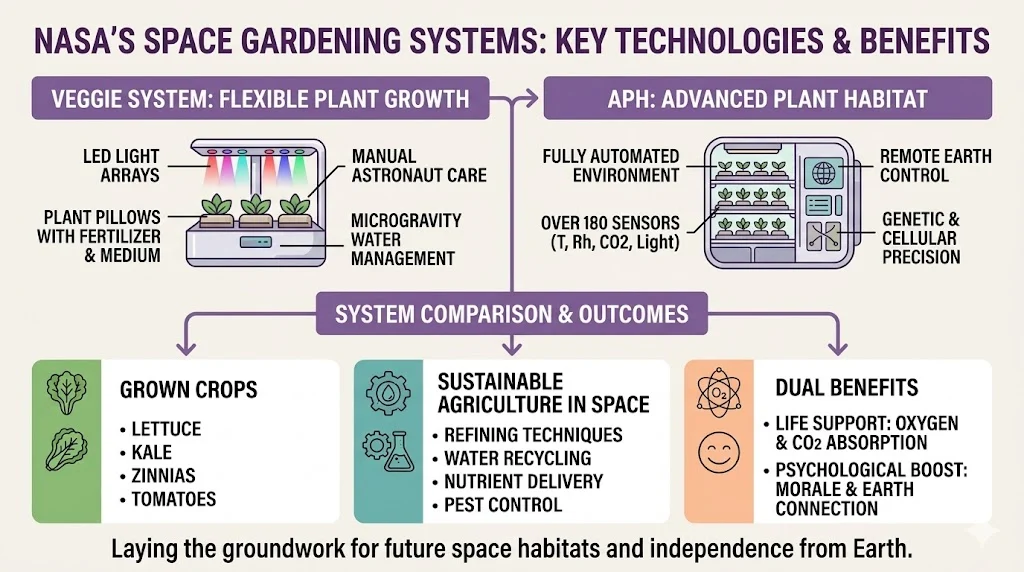
Spudnik-1 was a personal experiment. But there are also official systems designed for space farming that represent years of research and engineering by NASA and its partners.
One of the most widely used systems is called Veggie. It is a compact and flexible plant growth unit used aboard the ISS. Veggie uses red, blue, and green LED lights to simulate sunlight and optimize photosynthesis. Plants are grown in special “plant pillows” filled with a controlled-release fertilizer and a rooting medium that helps manage water distribution in microgravity.
Astronauts manually tend to these plants, which adds a human element to the process and allows for real-time observation and adjustments. Another advanced system is the Advanced Plant Habitat (APH). Unlike Veggie, APH is highly automated and designed for scientific precision.
It includes over 180 sensors that monitor environmental conditions such as temperature, humidity, carbon dioxide levels, and light intensity. Scientists on Earth can remotely control these variables, making APH ideal for conducting detailed plant biology experiments. This system helps researchers understand how plants respond to space conditions at a cellular and genetic level.
These systems have been used to grow crops such as:
- Lettuce
- Kale
- Zinnias
- Tomatoes
Beyond simply producing food, these experiments serve multiple purposes. They help scientists refine techniques for sustainable agriculture in space, including water recycling, nutrient delivery, and pest control. They also contribute to life-support systems by improving air quality through oxygen production and carbon dioxide absorption.
Equally important is the psychological benefit. Fresh plants provide a sense of normalcy and connection to Earth, which can significantly boost astronaut morale during long missions. Together, these systems are laying the groundwork for future space habitats where growing food will be essential for survival and independence from Earth.
Challenges of Growing Potatoes in Space
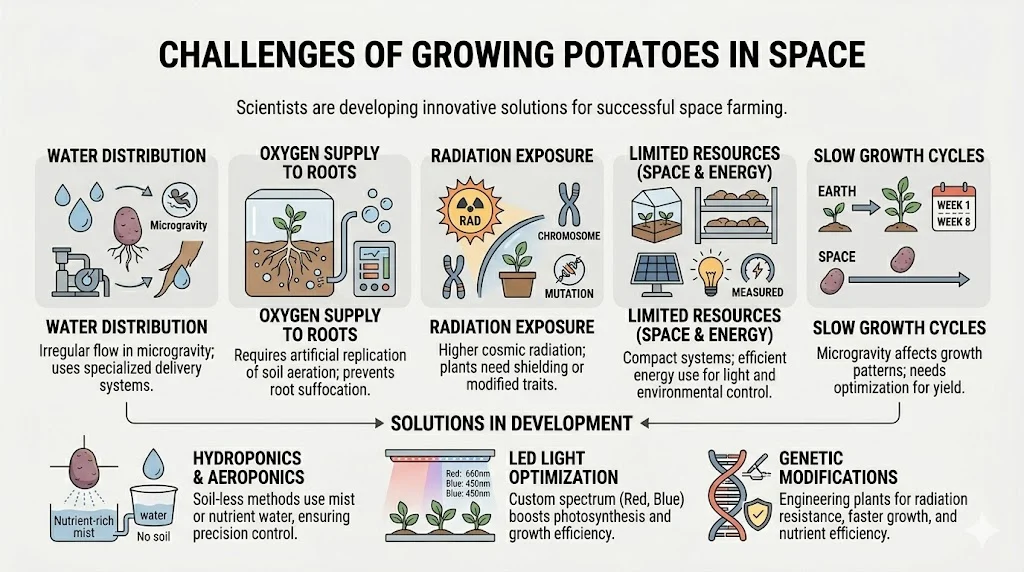
Even though potatoes are ideal for space farming, there are still many challenges that scientists must overcome before they can be reliably grown on long-duration missions. Unlike Earth, space presents a completely controlled and artificial environment where every variable must be carefully managed. Even small imbalances can affect plant health and yield.
Some of the key challenges include:
- Managing water distribution
- Ensuring proper oxygen supply to roots
- Dealing with radiation exposure
- Limited space and energy resources
- Slower growth cycles
Water management is particularly complex in microgravity. Without gravity, water does not flow downward but instead forms floating droplets that can cling to surfaces or roots. This can lead to uneven hydration or even root suffocation if not properly controlled. Scientists use specialized delivery systems to ensure that water reaches plant roots in a consistent and safe manner.
Oxygen supply is another critical factor. On Earth, soil naturally allows air to circulate around roots. In space, artificial systems must replicate this balance to prevent roots from becoming deprived of oxygen, which can stunt growth or kill the plant.
Radiation exposure is also a concern. Outside Earth’s protective atmosphere, plants are exposed to higher levels of cosmic radiation. While potatoes have shown some resilience, long-term exposure could affect growth patterns or genetic stability.
Scientists are exploring solutions such as hydroponics and aeroponics. These methods do not use soil. Instead, they use nutrient-rich water or mist, allowing for precise control over nutrients and reducing the risk of contamination.
Lighting is also optimized using LED systems. Different wavelengths of light help plants grow more efficiently, with red and blue light being particularly effective for photosynthesis.
In the future, genetic modifications may help create plants that are better suited for space environments, making them more resistant to radiation, faster-growing, and more efficient in using limited resources.
The Human Side of This Experiment
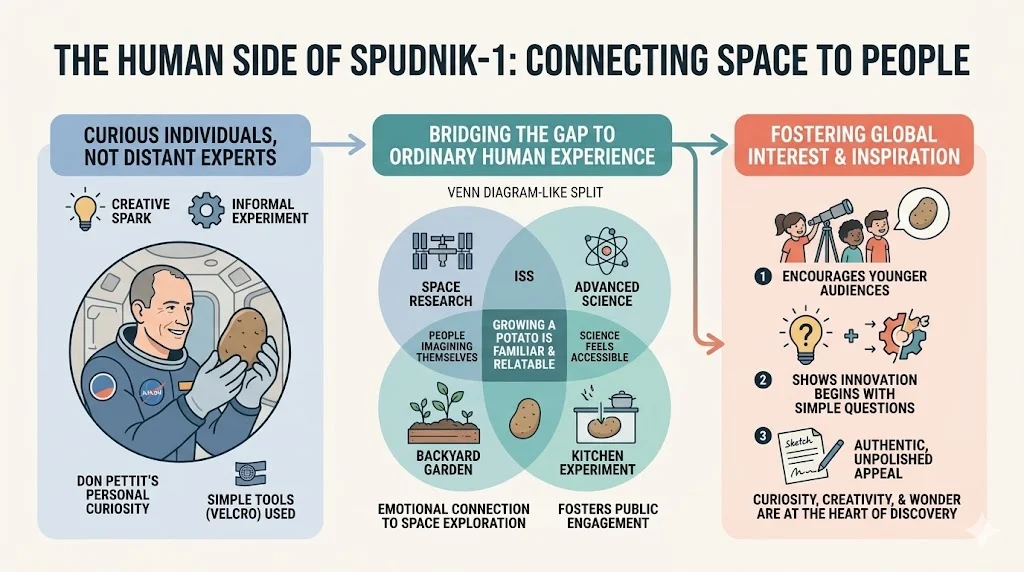
One reason this story became viral is its strong human element, which resonates deeply with audiences beyond the scientific community.
Spudnik-1 was not part of a large, highly funded scientific program. Instead, it was a small, personal experiment carried out by Don Pettit using simple tools available aboard the space station. This approach highlights an important truth about science: groundbreaking insights do not always come from complex systems or massive teams. Sometimes, they emerge from curiosity, observation, and a willingness to experiment with everyday objects.
What makes this story particularly compelling is how it bridges the gap between advanced space research and ordinary human experience. People could easily imagine themselves trying something similar, even if not in space. The idea of growing a potato is familiar to many, whether in a backyard garden or a kitchen experiment. Seeing that same activity take place in orbit makes the science feel accessible rather than distant or intimidating.
This relatability plays a crucial role in public engagement. When people see astronauts as curious individuals rather than distant experts, it fosters a stronger emotional connection to space exploration. It also encourages younger audiences to take an interest in science, showing them that innovation often begins with simple questions and creative thinking.
Additionally, the informal nature of the experiment adds authenticity. It was not designed for headlines or publicity, yet it captured global attention. This organic appeal is rare and powerful in today’s digital landscape, where audiences are constantly exposed to polished and highly produced content.
Ultimately, the human connection behind Spudnik-1 transformed it from a simple experiment into a widely shared story. It reminds us that curiosity, creativity, and a sense of wonder are at the heart of all scientific discovery.
Public Reaction and Cultural Impact
When the image first appeared online, people were confused and amused. Many thought it was something dangerous or alien. Social media was filled with jokes and reactions. Some compared it to creatures from horror movies.
But once the truth came out, the reaction changed. People started appreciating the experiment. They found it interesting and inspiring. This story shows how science can capture public attention. It also highlights the power of social media in spreading knowledge.
The Role of the International Space Station
The International Space Station has been a key platform for scientific research for over two decades, acting as humanity’s most advanced laboratory in orbit. Since its first modules were launched in 1998, the ISS has hosted thousands of experiments conducted by scientists from around the world. Its unique environment allows researchers to observe phenomena that simply cannot be replicated on Earth, making it an essential hub for innovation and discovery.
One of the most valuable aspects of the ISS is its microgravity environment. In the absence of gravity, scientists can study how physical, chemical, and biological processes behave differently. This includes research on human health, such as muscle atrophy, bone density loss, and the effects of long-term space travel on the immune system. These findings not only help astronauts stay healthy but also contribute to medical advancements on Earth, including treatments for osteoporosis and muscle degeneration.
The ISS also plays a crucial role in materials science and engineering. Without gravity-driven convection, materials can form in more uniform ways, allowing scientists to develop stronger alloys, improved semiconductors, and more efficient manufacturing techniques. Additionally, plant growth experiments, like the Spudnik-1 potato, provide insights into how crops can be cultivated in space, which is vital for future missions.
Beyond research, the ISS serves as a testing ground for new technologies. Systems for life support, water recycling, and energy efficiency are continuously refined in orbit. These technologies will be essential for long-duration missions to the Moon, Mars, and beyond.
However, the ISS is expected to retire in the coming years, marking the end of an era. This makes ongoing experiments even more critical, as they provide valuable data that will shape the design and operation of next-generation space stations and deep-space habitats.
The Future of Space Farming
The story of Spudnik-1 is just the beginning. Future missions to the Moon and Mars will require advanced farming systems that go far beyond simple experiments. Astronauts will need to grow their own food reliably, efficiently, and at scale. This will reduce the need for constant resupply from Earth, which is both expensive and risky for long-duration missions.
Space agencies are working on systems that can support long-term living. These include:
- Closed-loop ecosystems: These systems recycle air, water, and waste to create a self-sustaining environment. Plants play a central role by producing oxygen, purifying water, and even helping manage carbon dioxide levels.
- Automated farming systems: Automation reduces the need for constant human intervention. Sensors monitor plant health, nutrient levels, and environmental conditions, allowing crops to grow consistently even when astronauts are busy with other mission tasks.
- AI-controlled environments: Artificial intelligence can optimize lighting, temperature, humidity, and nutrient delivery in real time. This ensures maximum crop yield while minimizing resource use, which is critical in space where every resource is limited.
- Sustainable resource management: Efficient use of water, energy, and nutrients is essential. Technologies like hydroponics and aeroponics allow plants to grow with minimal waste, making them ideal for space habitats.
Potatoes and similar crops will play a key role in these systems because they are calorie-dense, adaptable, and capable of growing in controlled environments. Their versatility makes them a strong candidate for feeding astronauts on future missions beyond Earth.
From ISS to Mars: Connecting the Dots
Let us connect everything together. At first look a small potato floating inside a spacecraft might seem like a humorous or trivial experiment. However, when viewed through a broader scientific and exploratory lens, it becomes clear that this simple object represents a critical step forward in humanity’s journey beyond Earth.
Spudnik-1 is not just a curiosity it is a proof of concept that demonstrates how life can be sustained in environments where traditional agricultural methods no longer apply. This experiment highlights the remarkable adaptability of both plants and humans. In microgravity, where natural growth patterns are disrupted, scientists are forced to rethink how food production works.
By observing how a potato behaves in space, researchers gain valuable insights into plant biology, resource management, and environmental control systems. These insights are essential for designing sustainable life-support systems that can function independently of Earth.
Looking ahead, future astronauts will not have the luxury of relying solely on supply missions. Long-duration missions to Mars or deep space will require self-sufficiency, and that includes growing food on-site. Crops like potatoes are ideal candidates due to their nutritional value, resilience, and efficiency. Controlled habitats, equipped with advanced lighting, water recycling, and atmospheric regulation, will become miniature ecosystems capable of supporting human life.
Experiments like Spudnik-1 serve as foundational building blocks for these future systems. They bridge the gap between theory and practical application, turning abstract ideas into tangible progress. In essence, what may appear to be a simple floating potato is actually a symbol of innovation, resilience, and the next chapter of human exploration.
My Final Words
The story of Spudnik-1 is more than just a viral moment. It is a glimpse into the future of humanity. It combines science, creativity, and curiosity in a simple yet powerful way. It shows that even small experiments can lead to big insights.
In my opinion, this is what makes space exploration truly exciting. It is not only about reaching new places. It is also about learning how to live there. If a simple potato can teach us how to survive in space, then the possibilities are endless. And that is what makes this story worth remembering.
Related Posts :




Share This Post