How Many Solar Panels Do I Need: Complete 2026 Guide with Calculator, Formula and Real Examples
How Many Solar Panels Do I Need?
Installing solar panels is one of the smartest investments for homeowners in 2026. Rising electricity costs, government subsidies, and falling solar prices make rooftop solar more attractive than ever. But the first question every homeowner asks is simple: how many solar panels do I need?
The answer depends on your electricity usage, roof size, location, and the type of panels you choose. There is no one-size-fits-all number. A small apartment might need only 4 panels while a large villa could require 25 or more. This comprehensive guide breaks down everything you need to know to calculate your exact solar panel requirement.
This article covers the simple formula for calculating solar panels needed, specific requirements for different home sizes including 2,000 square foot homes, monthly usage calculations for high consumption like 4,000 kWh per month, roof space requirements, costs in India with subsidies, and the latest 2026 panel efficiency trends.
Table of Contents
Quick Answer: How Many Solar Panels Do I Need?
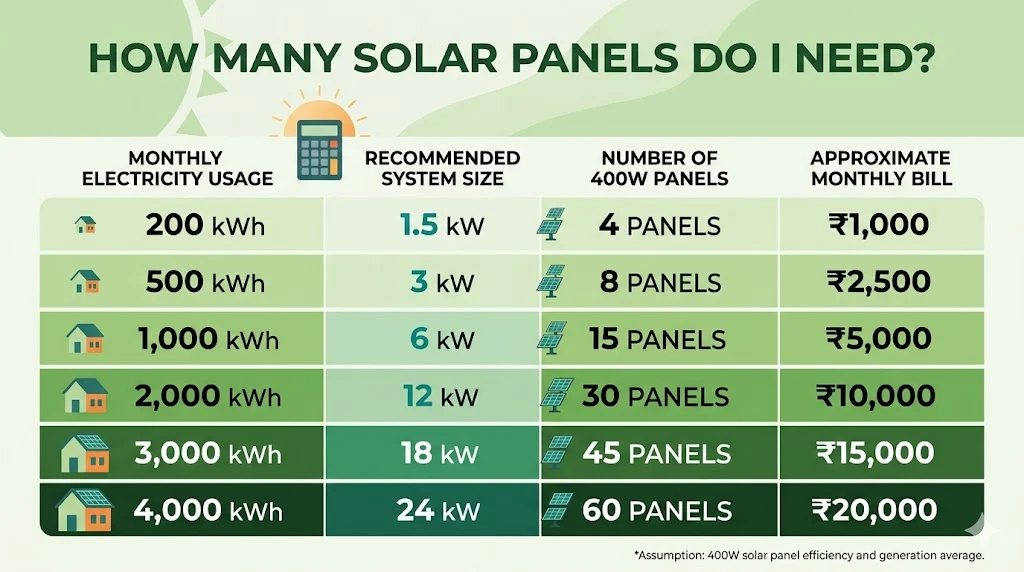
Before diving into calculations, here is a quick reference table based on monthly electricity consumption. These estimates assume modern 400W solar panels and average sunlight conditions in India.
| Monthly Electricity Usage (kWh) | Recommended System Size | Number of 400W Panels Needed | Approximate Monthly Bill (₹) |
|---|---|---|---|
| 200 to 300 kWh | 1.5 to 2 kW | 4 to 6 panels | ₹1,500 to ₹2,500 |
| 300 to 500 kWh | 2 to 3 kW | 6 to 8 panels | ₹2,500 to ₹4,000 |
| 500 to 700 kWh | 3 to 5 kW | 8 to 13 panels | ₹4,000 to ₹6,000 |
| 700 to 1,000 kWh | 5 to 7 kW | 13 to 18 panels | ₹6,000 to ₹9,000 |
| 1,000 to 1,500 kWh | 7 to 10 kW | 18 to 25 panels | ₹9,000 to ₹14,000 |
| 1,500 to 4,000 kWh | 10 to 30 kW | 25 to 75 panels | ₹14,000 to ₹35,000 |
For a typical Indian home with a monthly electricity bill of ₹2,000 to ₹3,000, you will generally need between 6 and 10 solar panels of 400W each. Higher wattage panels of 500W or 550W will reduce the total count needed.
The Solar Panel Calculator Formula
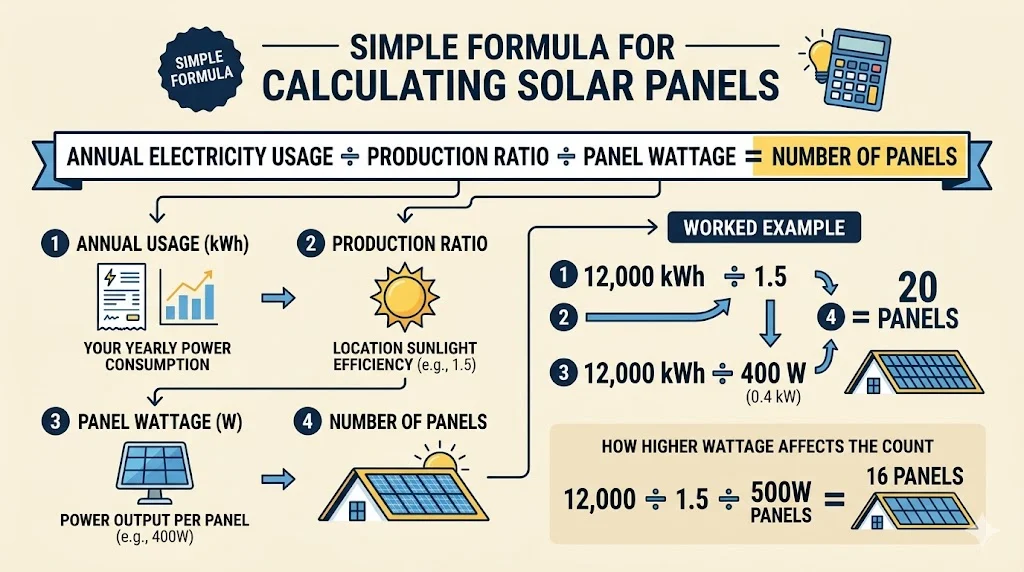
The most accurate way to determine how many solar panels you need is to use the standard calculation formula used by solar installers worldwide.
Number of Panels = Annual Electricity Usage (kWh) ÷ Production Ratio ÷ Panel Wattage (kW)
Here is what each term means:
Annual Electricity Usage: This is the total units of electricity you consume in a year. Check your electricity bill for monthly usage in kWh and multiply by 12. For example, if you use 500 kWh per month, your annual usage is 6,000 kWh.
Production Ratio: This accounts for the sunlight hours and efficiency losses in your location. In India, the production ratio typically ranges from 1.3 to 1.6. Sunny states like Rajasthan and Gujarat have higher ratios around 1.5 to 1.6. States with less sun or more cloudy days have lower ratios around 1.3 to 1.4.
Panel Wattage: This is the power rating of each solar panel. Divide the wattage by 1000 to convert to kilowatts. A 400W panel becomes 0.4 kW. A 500W panel becomes 0.5 kW.
Example Calculation:
Let us say your annual electricity usage is 12,000 kWh. You live in an area with a production ratio of 1.5. You plan to use 400W panels.
Calculation: 12,000 ÷ 1.5 ÷ 0.4 = 20 panels
This means you need 20 solar panels of 400W each to meet your annual electricity needs. If you choose higher efficiency 500W panels instead, the calculation changes: 12,000 ÷ 1.5 ÷ 0.5 = 16 panels. You save 4 panels by choosing higher wattage panels.
Step by Step Calculation Method
Follow these simple steps to calculate exactly how many solar panels you need for your home.
Step 1: Check Your Electricity Bill
Look at your most recent electricity bill and find your monthly consumption in units or kWh. This is usually displayed prominently on the first page. If you have bills for multiple months, calculate the average to account for seasonal variations. Summer months typically show higher usage due to air conditioning.
Step 2: Calculate Annual Electricity Usage
Multiply your average monthly usage by 12 to get your annual consumption. For example, if you use 600 kWh per month, your annual usage is 7,200 kWh. If your usage varies significantly between summer and winter, use the highest month and multiply by 12 to ensure your system is sized for peak demand.
Step 3: Determine Your Production Ratio
Identify your location’s production ratio. In India, most regions receive 4.5 to 6.5 peak sun hours per day. The national average is 5 to 5.5 hours. Use these guidelines:
- Rajasthan, Gujarat, Tamil Nadu: Production ratio 1.5 to 1.6
- Central India: Production ratio 1.4 to 1.5
- Northern states with winter fog: Production ratio 1.3 to 1.4
- Coastal areas with humidity: Production ratio 1.4 to 1.5
Step 4: Select Your Panel Wattage
Choose the wattage of panels you plan to install. In 2026, the most common options are:
- Standard panels: 330W to 400W
- High efficiency panels: 400W to 500W
- Premium panels: 500W to 550W
Higher wattage panels cost more per panel but reduce the total number needed and the installation area required.
Step 5: Apply the Formula
Insert your numbers into the formula: Annual Usage ÷ Production Ratio ÷ Panel Wattage in kW = Number of Panels. Round up to the nearest whole number since you cannot install partial panels.
How Many Solar Panels Do I Need Per Month
Many homeowners want to size their system based on monthly electricity usage rather than annual. This approach works well if your usage is consistent throughout the year.
To calculate panels needed per month, first determine your daily energy requirement. Divide your monthly kWh by 30 days. Then divide by the daily production per panel.
A 400W panel in India typically produces 1.6 to 2.0 kWh per day depending on location and season. In sunny states, expect 2.0 kWh per day. In less sunny areas, expect 1.6 kWh per day.
Example for 600 kWh Monthly Usage:
Daily usage: 600 ÷ 30 = 20 kWh per day
Daily production per 400W panel: 1.8 kWh (average)
Panels needed: 20 ÷ 1.8 = 11.1 panels
Round up to 12 panels
Monthly Usage Reference Table:
| Monthly Usage (kWh) | Daily Usage (kWh) | Panels Needed (400W) | Panels Needed (500W) |
|---|---|---|---|
| 200 kWh | 6.7 kWh | 4 panels | 3 panels |
| 400 kWh | 13.3 kWh | 8 panels | 6 panels |
| 600 kWh | 20 kWh | 12 panels | 9 panels |
| 800 kWh | 26.7 kWh | 15 panels | 12 panels |
| 1,000 kWh | 33.3 kWh | 19 panels | 15 panels |
| 2,000 kWh | 66.7 kWh | 37 panels | 30 panels |
| 4,000 kWh | 133.3 kWh | 74 panels | 59 panels |
Remember that solar production varies by season. Summer months yield 20 to 30% more power than winter months in most parts of India. Monsoon seasons can reduce output by 10 to 25%. Size your system based on your highest usage months or accept that grid power will supplement your needs during low production periods.
How Many Solar Panels Do I Need for a 2,000 Sq Ft Home
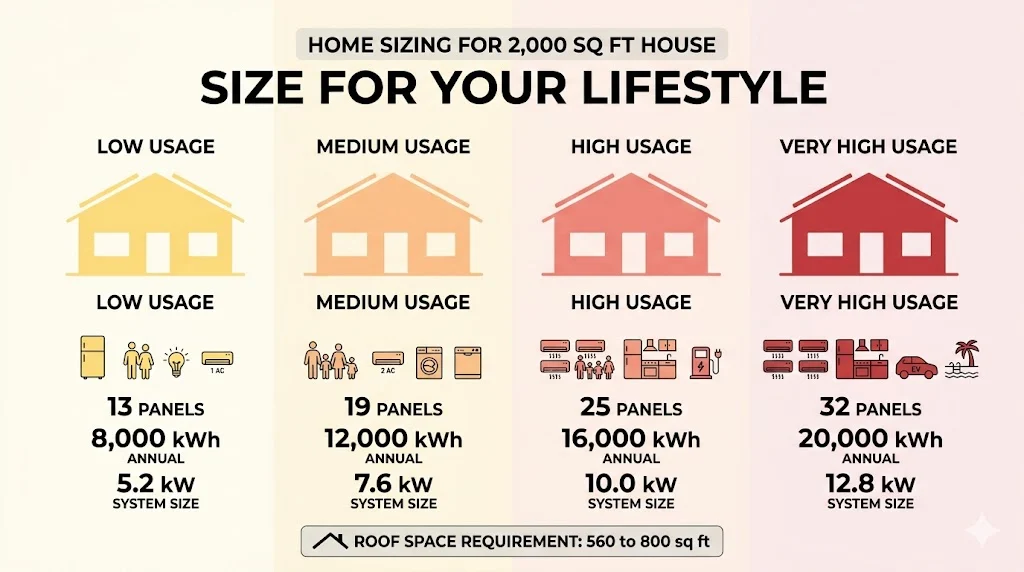
Home size is not the most accurate way to determine solar panel needs, but it provides a useful starting point for estimation. Two homes of identical size can have vastly different energy needs based on occupancy, appliances, and lifestyle.
A 2,000 square foot home in India typically uses between 12,000 and 16,000 kWh per year. This translates to 1,000 to 1,333 kWh per month. However, this range varies significantly.
Factors that increase energy usage in a 2,000 sq ft home include:
- Number of occupants: A family of 5 uses more power than a couple
- Air conditioning: Central AC or multiple split units consume significant power
- Electric water heaters: Replace gas geysers for higher electricity bills
- Home office equipment: Computers, printers, and servers running all day
- Electric vehicles: EV charging can double your electricity consumption
- Swimming pools: Pumps and heaters are energy intensive
For a typical 2,000 sq ft home with moderate usage, you will need between 16 and 21 solar panels of 400W each. This assumes annual consumption of 10,000 to 12,000 kWh and average sunlight conditions.
Detailed Breakdown for 2,000 Sq Ft Home:
| Usage Level | Annual kWh | System Size | 400W Panels | 500W Panels |
|---|---|---|---|---|
| Low (couple, no AC) | 8,000 kWh | 5 kW | 13 panels | 10 panels |
| Medium (family of 4, 1 AC) | 12,000 kWh | 7.5 kW | 19 panels | 15 panels |
| High (family of 5, 2 ACs, EV) | 16,000 kWh | 10 kW | 25 panels | 20 panels |
| Very High (all electric, pool) | 20,000 kWh | 12.5 kW | 32 panels | 25 panels |
To get an accurate count for your specific 2,000 sq ft home, review your past 12 months of electricity bills. Add up the total kWh and use the formula provided earlier. Do not rely solely on square footage estimates.
How Many Solar Panels Do I Need for 4,000 kWh Per Month
A monthly consumption of 4,000 kWh is considered very high for a residential property. This level of usage typically indicates a large home, multiple air conditioners, electric heating, or EV charging. Some small commercial establishments also fall into this category. Daily usage at 4,000 kWh per month equals 133.3 kWh per day. This requires a substantial solar system.
Calculation for 4,000 kWh Monthly:
Annual usage: 4,000 × 12 = 48,000 kWh
Production ratio: 1.5 (average India)
Panel wattage: 400W (0.4 kW)
Formula: 48,000 ÷ 1.5 ÷ 0.4 = 80 panels
You would need approximately 80 panels of 400W each to generate 4,000 kWh per month. This is a 32 kW system requiring significant roof space.
Alternative with Higher Wattage Panels:
Using 500W panels: 48,000 ÷ 1.5 ÷ 0.5 = 64 panels
Using 550W panels: 48,000 ÷ 1.5 ÷ 0.55 = 58 panels
System Losses Consideration:
Solar systems experience energy losses due to wiring, inverter efficiency, shading, and temperature. These losses typically range from 10% to 15%. To compensate, increase your panel count by 10% to 15%. Adjusted calculation for 4,000 kWh with 12% losses: 80 panels × 1.12 = 90 panels of 400W each.
Regional Variations:
In very sunny locations like Rajasthan with 6.5 peak sun hours, you might achieve 4,000 kWh per month with only 43 panels of 400W. In less sunny regions with 4.5 peak sun hours, you might need 87 panels of 350W.
For such high consumption, consider a hybrid system with battery storage to maximize self-consumption and reduce grid dependence.
Roof Space Requirements for Solar Panels
Roof space is often the limiting factor for solar installations. Understanding space requirements helps you determine the maximum system size your roof can accommodate.
General Rule: 1 kW of solar panels requires approximately 80 to 100 square feet of roof space. This accounts for panel area plus necessary spacing between rows for maintenance and ventilation.
Space Requirements by System Size:
| System Size | Roof Space Needed | Typical Panel Count |
|---|---|---|
| 1 kW | 80 to 100 sq ft | 2 to 3 panels |
| 2 kW | 160 to 200 sq ft | 5 to 6 panels |
| 3 kW | 240 to 300 sq ft | 8 to 10 panels |
| 5 kW | 400 to 500 sq ft | 13 to 16 panels |
| 7 kW | 560 to 700 sq ft | 18 to 23 panels |
| 10 kW | 800 to 1,000 sq ft | 25 to 32 panels |
Panel Dimensions:
Standard 400W solar panels measure approximately 2 meters by 1 meter (6.5 feet by 3.3 feet). This equals about 2 square meters or 21.5 square feet per panel. However, you cannot cover your entire roof with panels. Setbacks and spacing reduce usable area.
Usable Roof Percentage:
Not all roof space can be used for solar panels. Fire codes require setbacks of 4 to 6 feet from roof edges. Obstacles like chimneys, vents, and skylights further reduce available space. A typical roof has 70% to 85% usable area after accounting for these factors.
Calculation Example:
Total roof area: 1,000 sq ft
Usable percentage: 80%
Usable area: 800 sq ft
Space per kW: 90 sq ft
Maximum system size: 800 ÷ 90 = 8.9 kW
Panels at 400W: 8.9 ÷ 0.4 = 22 panels
If your roof space is limited, choose high-efficiency panels. A 500W panel produces 25% more power than a 400W panel in the same space. Premium panels with 550W output can maximize production from small roofs.
Roof Direction and Tilt:
South-facing roofs in India receive the most sunlight and require fewer panels. East or west-facing roofs work well but may need 10% to 15% more panels for the same output. North-facing roofs are least ideal and may need 20% to 30% more panels.
The optimal tilt angle equals your latitude. For most of India, this ranges from 15 to 25 degrees. Flat roofs require mounting structures to achieve proper tilt, which adds cost but improves production.
Solar Panel Costs in India with Subsidies 2026
Understanding costs helps you plan your solar investment. Solar prices in India have fallen significantly, and government subsidies make systems more affordable than ever.
Current Solar Prices in India (2026):
| System Size | Price Range (₹) | After PM Surya Ghar Subsidy |
|---|---|---|
| 1 kW | ₹60,000 to ₹1,00,000 | ₹30,000 to ₹70,000 |
| 2 kW | ₹1,10,000 to ₹1,50,000 | ₹70,000 to ₹1,10,000 |
| 3 kW | ₹1,70,000 to ₹2,30,000 | ₹92,000 to ₹1,52,000 |
| 4 kW | ₹2,30,000 to ₹3,00,000 | ₹1,52,000 to ₹2,22,000 |
| 5 kW | ₹3,00,000 to ₹4,00,000 | ₹2,22,000 to ₹3,22,000 |
| 10 kW | ₹5,60,000 to ₹6,40,000 | ₹4,82,000 to ₹5,62,000 |
PM Surya Ghar Muft Bijli Yojana Subsidy Structure:
The government offers substantial subsidies under the PM Surya Ghar scheme launched in February 2024. As of March 2026, the scheme has added 9.57 GW of rooftop solar capacity across India.
- Up to 2 kW: ₹30,000 per kW subsidy
- 3 kW and above: Fixed ₹78,000 subsidy
- Additional state subsidies available in some regions
In Uttar Pradesh and Delhi, state governments offer an additional ₹30,000 subsidy, bringing total savings to ₹1,08,000 for a 10 kW system.
Cost Per Watt:
The average solar panel price per watt in India ranges from ₹70 to ₹80. Complete system costs including installation, inverter, and mounting structure range from ₹40,000 to ₹70,000 per kW before subsidy.
Return on Investment:
A typical residential solar system pays for itself in 3 to 5 years through electricity savings. Over the 25-year lifespan, homeowners save ₹35 to ₹70 lakhs depending on local electricity tariffs and consumption patterns.
Electricity tariffs in India increase by 3% to 10% annually. Solar protects you from these rising costs. After the payback period, you enjoy virtually free electricity for 20 or more years.
Latest Solar Panel Efficiency Trends 2026
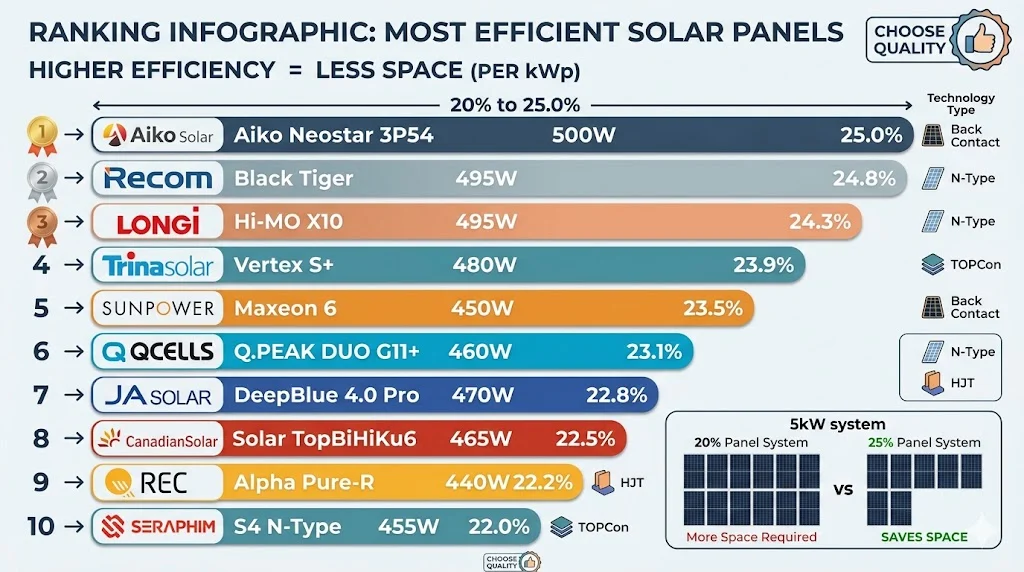
Solar panel technology has advanced rapidly. Understanding efficiency trends helps you choose the best panels for your needs.
Top 10 Most Efficient Residential Solar Panels 2026:
| Rank | Brand | Model | Wattage | Efficiency |
|---|---|---|---|---|
| 1 | Aiko Solar | Neostar 3P54 | 500W | 25.0% |
| 2 | Recom Technologies | Black Tiger Series | 495W | 24.8% |
| 3 | LONGi Solar | Hi-MO X10 Explorer | 495W | 24.3% |
| 4 | Maxeon (SunPower) | Maxeon 7 | 445W | 24.1% |
| 5 | Jinko Solar | Tiger NEO III | 520W | 24.0% |
| 6 | Suntech | Ultra BC | 480W | 24.0% |
| 7 | Trina Solar | Vertex S+ | 475W | 23.8% |
| 8 | Winaico | WST-485BDX54 | 485W | 23.8% |
| 9 | Risen | N-type Topcon | 475W | 23.8% |
| 10 | Astronergy | Astra N7 2.0 | 530W | 23.8% |
Efficiency Impact:
Each 1% increase in efficiency provides approximately 30 to 40 additional watts per panel. A 24% efficient panel produces significantly more power than a 20% efficient panel of the same size.
For homes with limited roof space, high-efficiency panels are essential. A 25% efficient Aiko Solar panel can produce the same power as a 20% panel in 20% less space.
Technology Types:
- TOPCon (Tunnel Oxide Passivated Contact): Leading technology in 2026 with efficiencies up to 23.7%
- HJT (Heterojunction): Excellent temperature performance with coefficients as low as -0.24% per degree Celsius
- Back Contact: Highest efficiency ratings up to 25% with all electrical contacts on the rear
- Half-Cut Cells: Improved shade tolerance and reduced resistive losses
Temperature Coefficient:
High temperatures reduce panel output. Premium panels have temperature coefficients of -0.26% per degree Celsius or better. Standard panels may lose -0.35% per degree Celsius. In hot Indian summers, this difference significantly impacts daily production.
Degradation Rates:
Modern panels degrade slowly over time. Premium panels lose only 0.25% efficiency per year. After 25 years, they still produce 94% of original capacity. Standard panels may degrade 0.5% to 1% annually.
Factors That Affect Number of Solar Panels Needed
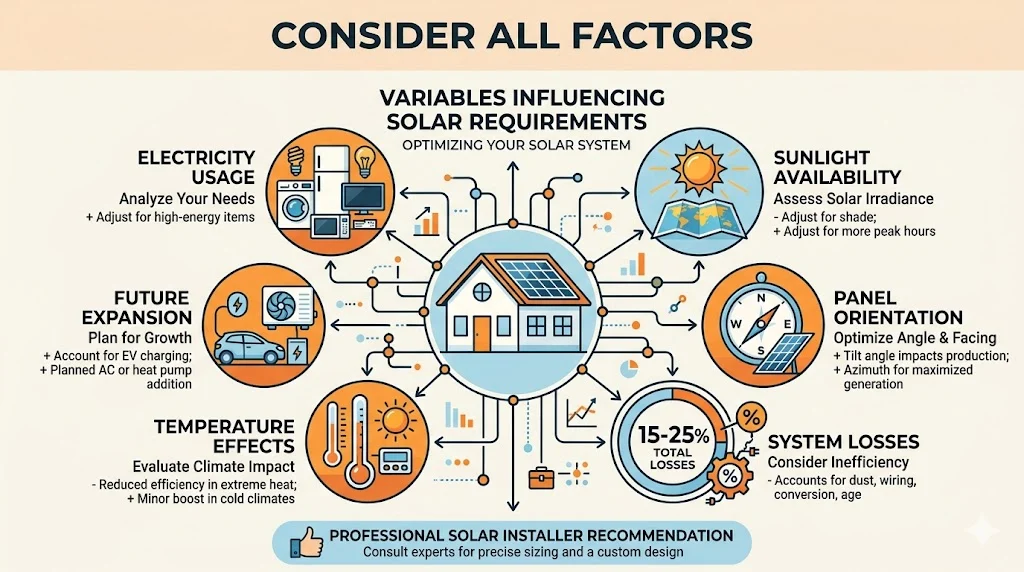
Several variables influence your final panel count. Understanding these helps you make informed decisions.
1) Electricity Usage Patterns:
Your consumption habits determine system size. Homes with all-electric appliances need larger systems than those using gas for cooking and heating. Air conditioning is the biggest variable. A 1.5 ton AC running 8 hours daily consumes approximately 1,800 to 2,000 watts continuously.
2) Sunlight Availability:
India receives excellent solar irradiance with 4.5 to 6.5 peak sun hours daily. However, regional variations exist. Rajasthan and Gujarat receive the most sun. Northeastern states and coastal areas with heavy monsoons receive less. Local weather patterns including fog, pollution, and dust also affect production.
3) Panel Orientation and Tilt:
South-facing panels at 15 to 25 degree tilt produce optimal results in India. East or west orientations reduce output by 10% to 15%. Flat roofs require tilted mounting structures. Shading from trees, buildings, or water tanks can drastically reduce production. Even partial shading on one panel can affect entire string performance.
4) System Losses:
Real-world systems experience losses from:
- Inverter inefficiency: 3% to 5% loss
- Wiring and connections: 1% to 2% loss
- Temperature effects: 8% to 15% loss in summer
- Dust and soiling: 5% to 20% loss without cleaning
- Shading: Variable depending on obstruction
Total system losses typically range from 15% to 25%. Oversize your system by 10% to 20% to compensate.
5) Future Expansion:
Consider future electricity needs when sizing your system. Planning to buy an electric vehicle? Add 2,000 to 3,000 kWh annually to your calculation. Installing central air conditioning? Add 3,000 to 5,000 kWh. Adding a swimming pool? Add 2,000 to 4,000 kWh for pumps and heating.
It is cheaper to install extra capacity initially than to expand later. Most inverters can handle 25% to 33% more panels than initially installed.
Solar Panels for Common Appliances
Sometimes you want to power specific appliances rather than your entire home. Here are common scenarios.
For 1.5 Ton Air Conditioner:
A 1.5 ton AC typically consumes 1,800 to 2,000 watts when running. For 8 hours daily operation, you need approximately 16 kWh per day. This requires 8 to 10 panels of 400W each assuming 5 peak sun hours. For consistent cooling, include battery storage or grid connection for nighttime operation.
For 1 HP Water Pump:
A 1 HP submersible pump uses approximately 1,200 watts. For 4 hours daily operation, you need 4.8 kWh per day. This requires 3 to 5 panels of 400W depending on sunlight. Solar water pumps are popular in agriculture and can operate directly from panels without batteries during daylight hours.
For Refrigerator:
A standard refrigerator consumes 1 to 2 kWh per day. This requires 1 to 2 panels of 400W. However, refrigerators run 24 hours while solar produces only during daylight. You need either grid connection or battery storage for nighttime operation.
For Electric Vehicle Charging:
An EV typically consumes 0.2 to 0.3 kWh per kilometer. For 50 km daily driving, you need 10 to 15 kWh per day. This requires 5 to 8 panels of 400W dedicated to EV charging. Many homeowners install separate EV charging solar systems.
Professional Tips Before Installing Solar
Follow these recommendations for a successful solar installation.
1) Always Oversize by 10% to 20%:
Install slightly more capacity than calculated. This compensates for system losses, panel degradation over time, and unexpected increases in usage. It is easier and cheaper to install extra panels initially than to expand later.
2) Choose High-Efficiency Panels for Limited Space:
If your roof space is constrained, prioritize efficiency over cost. A 24% efficient panel costs more but produces significantly more power per square foot. This can be the difference between meeting your energy needs or falling short.
3) Check for Shadows:
Conduct a shade analysis at different times of day and year. Morning shadows from neighboring buildings, afternoon shadows from trees, and seasonal sun angle changes all affect production. Remove obstacles where possible or adjust panel placement.
4) Consider Battery Backup:
Grid-tied systems without batteries shut down during power outages for safety reasons. If you want backup power during outages, add battery storage. Lithium-ion batteries are the standard in 2026 with 10 to 15 year lifespans.
Get Professional Site Inspection:
Online calculators provide estimates. A professional site inspection assesses roof condition, structural capacity, electrical panel compatibility, and shading. This ensures accurate system design and identifies potential issues before installation.
5) Verify Installer Credentials:
Choose MNRE-approved vendors for subsidy eligibility. Check installer reviews, warranties offered, and after-sales service. Quality installation affects system performance and longevity.
6) Understand Net Metering:
Net metering allows you to sell excess solar power to the grid and receive credits. This effectively uses the grid as a battery. Understand your state’s net metering policies, credit rollover rules, and any time-of-use pricing that affects solar economics.
Conclusion
Determining how many solar panels you need requires understanding your electricity consumption, local sunlight conditions, available roof space, and panel specifications. There is no universal answer. A small home might need 6 panels while a large home with high consumption might need 50 or more.
Use the formula provided in this guide for accurate calculations. Check your electricity bills, identify your location’s production ratio, and select appropriate panel wattage. Account for system losses and future expansion needs.
Solar energy is one of the best investments you can make in 2026. With government subsidies, falling prices, and rising electricity costs, the economics strongly favor solar adoption. Size your system correctly, choose quality components, and work with reputable installers.
Take time to calculate properly, assess your roof, and plan for the future. A well-sized solar system provides decades of clean, affordable energy while protecting you from rising utility rates. Start your solar journey today and enjoy the benefits of energy independence.
Related Posts :


![[Long Term] Tech & Telecom Stocks In India For Future Investment](https://personalloaneligibilitycalculator.in/wp-content/uploads/Long-Term-Tech-Telecom-Stocks-In-India-For-Future-Investment.webp)



Share This Post