Federal Reserve Interest Rate Cuts: What December 2025 Decision Means for Your Money
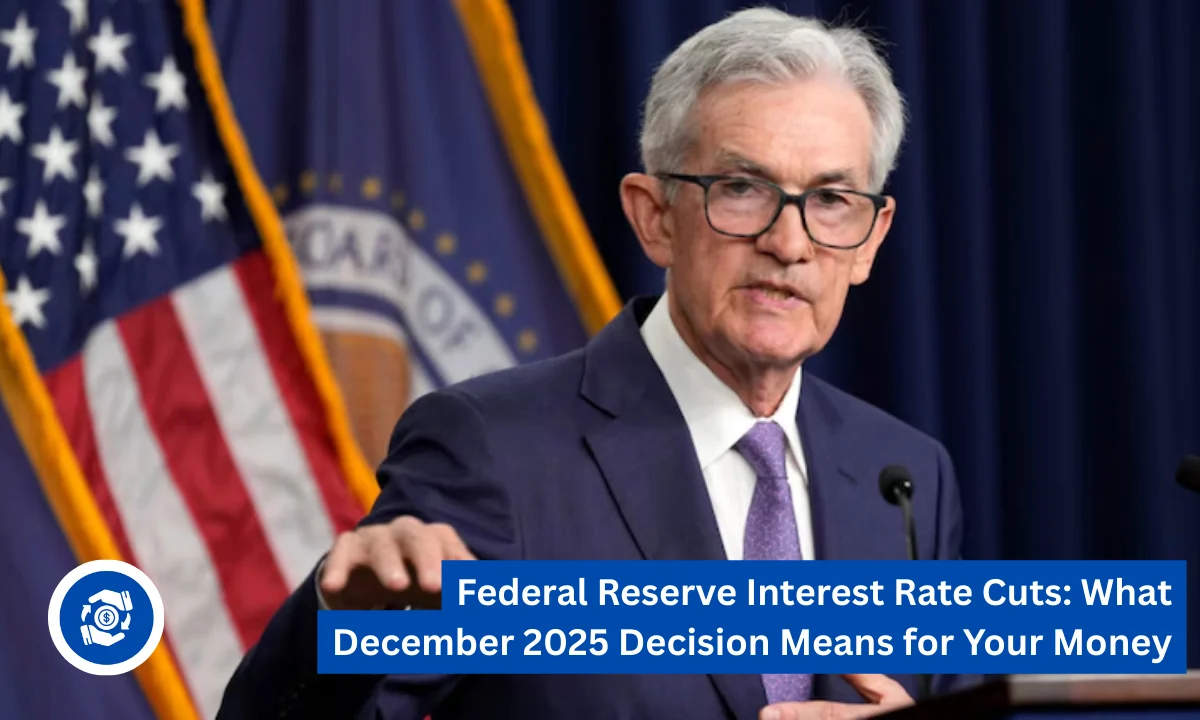
Federal Reserve Interest Rate Cuts: What December 2025 Decision Means for Your Money
Federal Reserve interest rate cuts have become the talk of the town in December 2025. The central bank just announced its third consecutive rate cut, lowering the benchmark rate by 25 basis points to a range of 3.50 to 3.75 percent.
This decision came after a heated debate within the Federal Open Market Committee, with a rare 9-3 vote showing deep divisions among policymakers. Fed Chair Jerome Powell emphasized that the central bank is now well positioned to wait and see how the economy evolves before making any further moves.
The rate cut aims to support a weakening labor market while inflation remains stubbornly above the 2 percent target. For everyday Americans, this means slightly cheaper borrowing costs for mortgages, car loans and credit cards. However, the Fed has signaled caution about future cuts, with projections showing just one more reduction expected in 2026.
Key Takeaways
- Federal Reserve cut interest rates by 25 basis points to 3.50-3.75 percent range in December 2025
- This marks the third consecutive rate cut since September 2024, totaling 1.75 percentage points reduction
- The decision passed with a divided 9-3 vote, showing disagreement among Fed officials
- Two officials wanted to hold rates steady while one governor pushed for a larger 50 basis point cut
- Fed Chair Jerome Powell indicated the central bank will pause and assess economic data before further cuts
- Only one additional rate cut is projected for 2026 according to the Fed’s dot plot
- Labor market weakness and delayed economic data due to government shutdown influenced the decision
- Mortgage rates have dropped to 6.19 percent, near the lowest levels of 2025
- President Trump criticized the Fed, demanding at least double the rate cut
- Stock markets rallied with S&P 500 closing up 0.7 percent after the announcement
Also Read: Hang Seng Index Trading at 25563 Points: What Investors Need to Know in December 2025
Understanding the December Rate Cut Decision
The Federal Reserve made a tough call in December 2025. The central bank reduced interest rates by 25 basis points despite facing pressure from multiple directions. On one side, officials worried about inflation that still hovers around 2.8 percent. On the other side, the labor market showed clear signs of weakness with unemployment at 4.4 percent.
Jerome Powell explained during his press conference that the committee decided to cut rates because of gradual cooling in the labor market. He revealed something surprising about recent jobs data. The Fed believes there has been an overstatement of about 60,000 jobs in recent numbers. This means the real job growth might be even weaker than reported figures suggest.
The voting pattern tells an interesting story. Nine members supported the quarter point cut while three dissented. Chicago Fed President Austan Goolsbee and Kansas City Fed President Jeffrey Schmid wanted to keep rates unchanged to fight inflation. Meanwhile, Fed Governor Stephen Miran pushed for a more aggressive 50 basis point reduction. This marked the first time in six years that an interest rate vote was so divided.
Impact of Government Shutdown on Fed Decision
The prolonged federal government shutdown created unusual challenges for the Fed. The 43-day shutdown that ended in mid-November delayed crucial economic data releases. Policymakers had to make their December decision without access to October employment statistics and current inflation readings.
Powell acknowledged this problem at the press conference. He said very little data on inflation has been released since the October meeting. The Fed had to rely on somewhat stale economic data from September. This information gap made the already difficult decision even more complicated for committee members.
The delayed data will arrive next week, including inflation and employment numbers for October and November. These reports could easily shift expectations for the January meeting. Powell stated that central bank officials will have to look at the delayed data carefully and with a skeptical eye given the technical issues related to data collection during the shutdown.
What This Means for Borrowers and Savers
The rate cut brings some relief for borrowers across different categories. Mortgage rates have already responded to earlier cuts. The average 30-year fixed mortgage rate stands at 6.19 percent, down from 6.69 percent a year ago. This translates to savings of hundreds of dollars annually for homebuyers on a typical home purchase.
Credit card holders and auto loan borrowers will also see some benefit. The quarter point reduction should make it slightly cheaper to carry a balance or finance a vehicle. Business owners looking to expand can access credit at lower costs. However, the impact of a single quarter point cut on household budgets remains modest.
Savers face a different situation. High-yield savings accounts have seen their annual percentage yields drop significantly. The average APY fell from 5.3 percent to 4.47 percent, a decrease of 83 basis points. This means people relying on savings interest will earn less on their deposits. The gap shows that Fed rate cuts have not fully filtered through to all consumer rates yet.
Political Pressure and Future Outlook
President Trump has been vocal about his dissatisfaction with the Fed’s pace of rate cuts. Just after the announcement, Trump stated at a White House event that the cut should have been at least doubled. He has consistently criticized Powell for being too late in cutting interest rates.
The political dynamics add another layer of complexity. Trump installed Stephen Miran, a White House economic adviser, to fill a short-term vacancy on the Fed board in September. Miran has voted consistently for larger rate cuts than his colleagues. Trump has also attempted to replace Fed Governor Lisa Cook over allegations that have not been proven, though the Supreme Court has blocked this effort so far.
Powell emphasized that the Fed operates independently from political pressure. When asked about his legacy, Powell said he wants to turn the job over to whoever replaces him with the economy in really good shape. He stressed the importance of bringing inflation back down to 2 percent while keeping the labor market strong.
Looking Ahead to 2026
The Fed’s latest economic projections paint a cautious picture for next year. The dot plot shows officials expect just one rate cut in 2026 and another in 2027. This represents a significant slowdown from the current pace of reductions. Six committee members actually expect no further cuts in 2026.
Market expectations align with this cautious stance. The CME FedWatch tool shows a 75.6 percent probability that the Fed will hold rates steady at its January meeting. This is up from 65.2 percent a week ago. Powell confirmed that policymakers are well positioned to wait and see how the economy performs before making additional moves.
Several factors will influence future decisions. The delayed economic data arriving next week could shift the narrative significantly. Tariff policies under the Trump administration may push inflation higher. Immigration policy changes and their impact on the labor market will also play a role. The Fed will need to carefully balance these competing forces as it navigates monetary policy in the coming year.
Related Posts :






Share This Post