30 Day Rule Meaning and Why It Is Still Relevant Today
30 Day Rule Meaning and Why It Is Still Relevant Today
The 30 day rule is a simple idea that appears in different areas of life. People often hear about it in breakups and dating advice. Others know it from money saving tips. Over time, this rule has taken different meanings, but the core idea stays the same. It creates distance from impulse and gives space to think clearly.
In recent years, the 30 day rule has become popular again due to online discussions on social platforms. People now question rigid timelines and focus more on personal growth. This article explains what the 30 day rule really means today, how it is used, and why many experts now see it as a starting point rather than a fixed rule.
Key Takeaways
- The 30 day rule is most commonly linked to no contact after a breakup
- Its main purpose is emotional healing and self control
- Public opinion now favors flexible or longer timelines
- The rule also applies to money habits and dating boundaries
- It works best when used for self improvement, not control
What Is the 30 Day Rule?
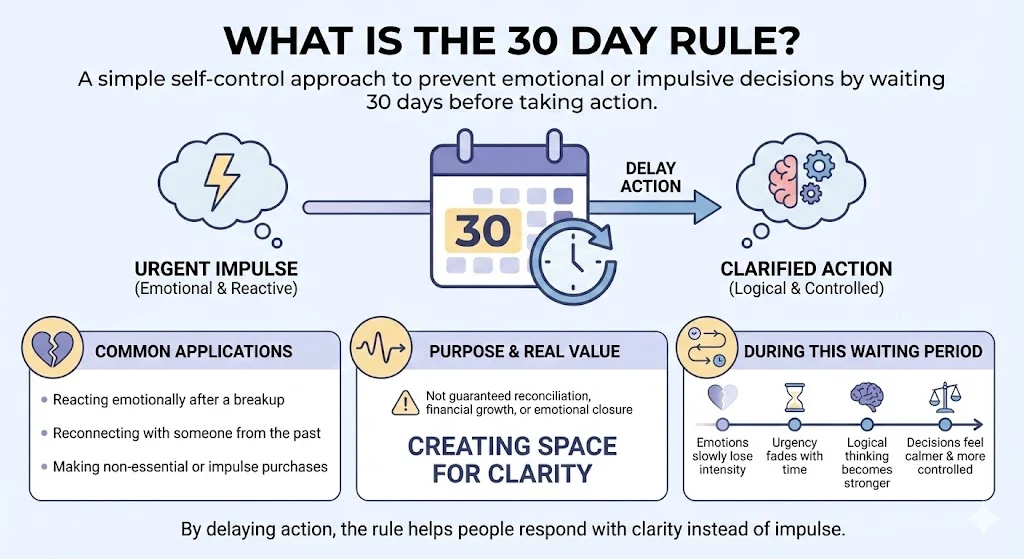
The 30 day rule is a simple self control approach used to prevent emotional or impulsive decisions. It asks a person to wait for 30 days before taking action on something that feels urgent in the moment.
The rule is commonly applied in these situations:
- Reacting emotionally after a breakup
- Reconnecting with someone from the past
- Making non essential or impulse purchases
The purpose of the 30 day rule is not to create guaranteed results. It does not promise reconciliation, financial growth, or emotional closure. Its real value lies in creating space.
During this waiting period:
- Emotions slowly lose intensity
- Urgency fades with time
- Logical thinking becomes stronger
- Decisions feel calmer and more controlled
By delaying action, the rule helps people respond with clarity instead of impulse.
The Most Common Meaning Today No Contact Rule
In modern usage, the 30 day rule mostly refers to the no contact rule after a breakup. This means cutting off all communication with an ex for at least 30 days. No calls. No texts. No social media interaction.
The goal is not punishment. The goal is emotional recovery. By removing constant reminders, the mind slowly adjusts to the new reality. Many people report reduced anxiety and better self control during this period.
This version of the rule became popular through dating coaches and self help blogs. Over time, it spread across platforms like X, TikTok, and Reddit.
Why People Use the 30 Day No Contact Rule
People turn to the 30 day no contact rule for several reasons. The most common reason is emotional pain after a breakup. Constant contact often keeps wounds open.
Another reason is habit breaking. Relationships create routines. Messages and calls become automatic. The rule interrupts this cycle and forces the brain to adapt.
Some people also hope their absence will trigger reflection in their ex. Experts now warn against using the rule for this purpose. When the rule is used as a waiting game, it often leads to disappointment.
What the Rule Actually Helps With
The strongest benefit of the 30 day rule is emotional detox. Distance reduces overthinking. It stops the constant checking of phones and profiles.
People also regain a sense of control. Instead of reacting to emotions, they start choosing actions consciously. This improves confidence and self respect.
Over time, many realize they feel calmer without contact. For some, this clarity leads to closure rather than reconciliation.
Is 30 Days Enough
Recent discussions suggest that 30 days is often not enough. Short relationships may heal faster. Long or intense relationships usually need more time.
Public opinion from 2025 and 2026 shows a shift toward open ended no contact. Many now see 30 days as a minimum, not a deadline. Healing does not follow calendars.
People who treat the rule as a countdown often stay emotionally stuck. Those who extend it until they feel stable report better outcomes.
Public Opinion on the 30 Day Rule
Online conversations show mixed views. Many praise the rule for helping them break toxic cycles. Others criticize it as a quick fix.
A growing number of people reject strict timelines. They prefer personal benchmarks like emotional calm or reduced attachment.
The admiration now goes to those who focus on self work. Gym routines, hobbies, therapy, and routine building are often highlighted as real success markers.
The 30 Day Rule in Dating Not Breakups
The rule also appears in dating advice outside breakups. Some use it as a pacing tool. Instead of rushing emotions, they observe behavior over time.
Modern dating discussions favor structured timelines. Examples include checking compatibility within three months or setting clear exclusivity goals.
This approach reduces situationships and emotional confusion. It also protects people from investing too much without clarity.
The 30 Day Rule in Personal Finance
Another popular version is the 30 day savings rule. This applies to money decisions rather than emotions. The idea is simple. Wait 30 days before buying non essential items.
This waiting period reduces impulse spending. Many people realize the desire fades over time. Money that would have been spent stays saved.
This rule is praised for building discipline. It also improves long term financial awareness.
How the Rule Builds Self Control
Whether emotional or financial, the rule trains impulse resistance. The brain learns to delay gratification. This skill has long term benefits.
People who follow the rule report better decision making. They feel less controlled by emotions or marketing pressure.
Over time, the habit of pausing becomes natural. The rule stops being an effort and turns into a mindset.
Common Mistakes People Make
One common mistake is obsessing over the other person. The rule fails if all attention stays external. Healing requires internal focus.
Another mistake is using the rule as manipulation. Waiting for a reaction from an ex keeps emotional dependence alive.
Some also break the rule repeatedly. Inconsistent boundaries confuse the brain and restart the emotional cycle.
A Healthier Way to Use the 30 Day Rule
The healthiest approach is to remove expectations. Use the rule for yourself, not for outcomes.
Focus on routines. Sleep schedules. Physical activity. Mental health support. These actions give the rule meaning.
If after 30 days clarity has not returned, extending the distance is reasonable. Healing is not failure. It is progress.
Why the Rule Still Matters in 2026
Despite criticism, the 30 day rule remains relevant. It offers structure during emotional chaos. It gives a clear first step when everything feels unclear.
The modern version is more flexible. It respects individual timelines. It prioritizes growth over control.
Used correctly, the rule is not outdated. It is evolving.
Final Thoughts On 30 Days Rule
The 30 day rule is not magic. It does not fix relationships or finances instantly. What it does is create space.
That space allows emotions to settle and logic to return. It helps people step out of reactive patterns.
In today’s world, the rule works best as a foundation. From there, personal awareness and self work take over.
Also Read: 28/36 Debt Rule Explained for Today’s Economy: This Rule Decides Your Mortgage
Tags: 30 day rule, no contact rule, breakup healing, impulse control, dating advice, personal growth
Related Posts :



![[Long Term] Tech & Telecom Stocks In India For Future Investment](https://personalloaneligibilitycalculator.in/wp-content/uploads/Long-Term-Tech-Telecom-Stocks-In-India-For-Future-Investment.webp)


Share This Post