Trump on France & UK: The Complete Breakdown of a Historic Alliance Rupture
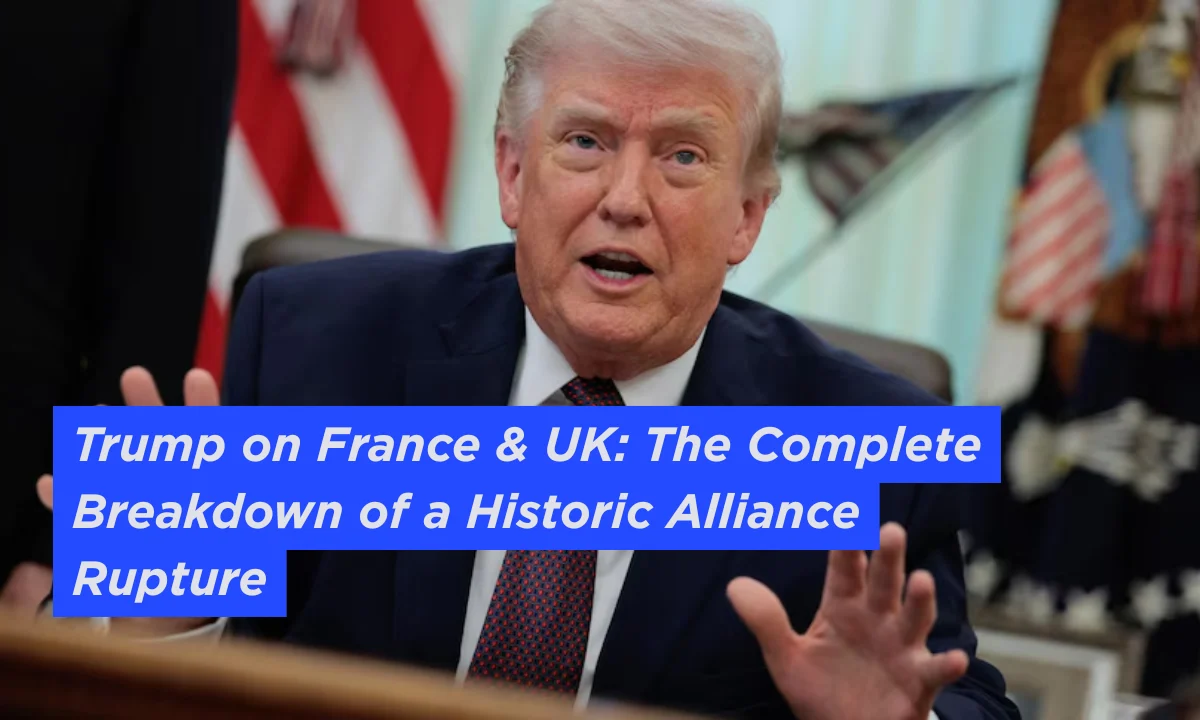
Trump on France & UK The Complete Breakdown of a Historic Alliance Rupture | Image Via © abc.net.au
When Old Allies Become Open Critics?
The relationship between the United States and its European allies has reached a breaking point. On March 31, 2026, President Donald Trump posted messages on Truth Social that sent shockwaves through diplomatic circles worldwide. His target was not a rival power or a hostile nation. It was America’s closest allies: the United Kingdom and France.
Trump wrote these words to the UK:
“All of those countries that can’t get jet fuel because of the Strait of Hormuz, like the United Kingdom, which refused to get involved in the decapitation of Iran, I have a suggestion for you: Number 1, buy from the U.S., we have plenty, and Number 2, build up some delayed courage, go to the Strait, and just TAKE IT. You’ll have to start learning how to fight for yourself, the U.S.A. won’t be there to help you anymore, just like you weren’t there for us.”
Minutes later, he attacked France:
“The Country of France wouldn’t let planes headed to Israel, loaded up with military supplies, fly over French territory. France has been VERY UNHELPFUL with respect to the ‘Butcher of Iran,’ who has been successfully eliminated! The U.S.A. will REMEMBER!!!”
These statements represent more than temporary frustration. They signal a fundamental shift in how the United States views its oldest alliances.
This article explains every aspect of this crisis:
- what Trump actually said?
- why he said it?
- how France and the UK responded?
- What it means for NATO? &
- how this could reshape global power structures for decades to come?
So Wheter you are geopolitics student, stock market investor or preparing for UPSC or any other exam this post is for you.. So keep readin..
Table of Contents
The Exact Words and Their Immediate Context
What Trump Posted on Truth Social
Understanding this crisis requires looking at Trump’s exact words. On the morning of March 31, 2026, Trump made two separate posts targeting European allies.
The first post focused on the UK and countries facing fuel shortages:
“All of those countries that can’t get jet fuel because of the Strait of Hormuz, like the United Kingdom, which refused to get involved in the decapitation of Iran, I have a suggestion for you: Number 1, buy from the U.S., we have plenty, and Number 2, build up some delayed courage, go to the Strait, and just TAKE IT. You’ll have to start learning how to fight for yourself, the U.S.A. won’t be there to help you anymore, just like you weren’t there for us. Iran has been, essentially, decimated. The hard part is done. Go get your own oil!”
The second post, made minutes later, targeted France specifically:
“The Country of France wouldn’t let planes headed to Israel, loaded up with military supplies, fly over French territory. France has been VERY UNHELPFUL with respect to the ‘Butcher of Iran,’ who has been successfully eliminated! The U.S.A. will REMEMBER!!!”
The Timeline of Escalation
This was not a single outburst. It was part of a pattern of increasing frustration from the Trump administration toward European allies. The context was the ongoing war with Iran, which began on February 28, 2026, when the United States and Israel launched coordinated attacks against Iranian targets.
For four weeks, the Trump administration had been conducting military operations with minimal participation from European NATO allies. France had restricted military overflights. Spain had refused use of its bases entirely. Italy had imposed procedural barriers that effectively prevented American strategic bombers from using Sicilian airbases. The UK, while providing some access to strategic assets, had refused to join the actual combat operations.
Defense Secretary Pete Hegseth amplified Trump’s message at a Pentagon press briefing on the same day. When asked about the Strait of Hormuz, he said: “This is an international waterway that we use less than most, in fact dramatically less than most. So the world ought to pay attention to be prepared to stand up. President Trump’s been willing to do the heavy lifting on behalf of the free world to address this threat of Iran. It’s not just our problem set going forward.”
Hegseth specifically mocked the British military: “Last time I checked, they’re supposed to have a big, bad Royal Navy prepared for things like this as well.”
The Real Reasons Behind Trump’s Anger
The Military Support Gap
The immediate trigger for Trump’s anger was the refusal of European allies to provide full military support for the Iran war. But the reasons for this refusal are complex and reveal deep structural problems in the NATO alliance.
France denied passage through its airspace for U.S. planes carrying ammunition to Israel. According to sources familiar with the matter, a plane was supposed to fly through French airspace over the weekend of March 28-29, 2026. Secretary of State Marco Rubio raised the issue with his French counterpart on the sidelines of a G7 meeting on Friday, March 27, but was rejected.
Spain went further, refusing the use of its military installations altogether. The Spanish government issued a blistering rebuke against what it perceived as an imperial attempt to dictate domestic security policy. Italy imposed stringent procedural mandates that effectively denied American strategic bombers sanctuary within Sicilian airbases.
The UK occupied a middle position. British Defense Secretary John Healey announced that the UK would send additional air defense support to the Gulf region, including a Sky Sabre air defense system deployed to Saudi Arabia and extended Royal Air Force Typhoon jets in Qatar. However, the UK refused to join the actual combat operations against Iran.
The Economic Pressure Factor
Trump’s frustration was amplified by economic pressures. The war had caused massive disruptions to global oil supplies, and the United States was bearing the military costs while allies complained about fuel shortages.
The numbers tell a stark story. The average price of a gallon of gasoline in the United States hit $4.02 on March 31, 2026, the highest since mid-2022. The national average had spiked more than a dollar since before the war began on February 28. Diesel fuel reached $5.45 per gallon, more than $1.80 higher than a year ago.
Brent crude, the international benchmark, was hovering around $106 per barrel on March 31, 2026, representing a rise of more than 45% since the war began. West Texas Intermediate crude had risen more than 50% since February 28.
Trump saw this as fundamentally unfair. The United States was spending billions on military operations, suffering casualties (348 U.S. service members had been injured since Operation Epic Fury started), and dealing with domestic fuel price increases. Meanwhile, European allies were refusing to share the military burden while facing the same economic pain.
The “Decapitation” Reference
Trump’s specific mention of the UK refusing to get involved in the “decapitation of Iran” refers to the killing of Iran’s Supreme Leader Ayatollah Ali Khamenei at the start of the war. The U.S. and Israel launched coordinated strikes on February 28, 2026, that killed Khamenei and other high-ranking Iranian officials.
This “decapitation strike” was the opening move of the war. European allies were informed but not consulted in advance. The UK and other NATO partners chose not to participate in this operation, viewing it as a dangerous escalation that could lead to broader regional conflict.
Trump views this refusal as a betrayal. He believes that if European allies benefit from the results of U.S. military action (the weakening of Iran), they should share in the risks and costs of achieving those results.
The Strait of Hormuz Crisis Explained
Why This Waterway Controls Global Economics
The Strait of Hormuz is not merely a shipping route. It is the central artery of the global energy system. This narrow waterway, which separates Iran from Oman and the United Arab Emirates, carries approximately 20% of the world’s oil supply and 25% of the world’s liquefied natural gas.
The strait is only 21 miles wide at its narrowest point, with shipping lanes just two miles wide in each direction. This makes it exceptionally vulnerable to military disruption. Iran has extensive military installations along its northern coast, including anti-ship missile batteries, naval bases, and air defense systems.
When the war began on February 28, 2026, Iran effectively closed the strait to most commercial shipping. The country used a combination of naval threats, missile attacks, and drone strikes to create a de facto blockade. By March 31, the strait was described as “almost completely shut,” with only occasional passages allowed for specific countries after coordination with Iranian authorities.
The Economic Impact in Numbers
The closure of the Strait of Hormuz has created what analysts call the most severe oil shock in decades. The effects are measurable across multiple indicators:
Global Oil Price Increases:
| Benchmark | Price on Feb 28, 2026 | Price on March 31, 2026 | Percentage Increase |
|---|---|---|---|
| Brent Crude | Approximately $73 | $106-113 | 45-55% |
| West Texas Intermediate | Approximately $59 | $102 | 73% |
| U.S. Gasoline Average | $2.95 | $4.02 | 36% |
| U.S. Diesel Average | $3.65 | $5.45 | 49% |
Shipping Disruptions:
The number of tankers attempting to navigate the strait dropped by approximately 90% in the first two weeks of the war. Dozens of oil and gas facilities across the region have been targeted and damaged by Iranian retaliation, including fields, refineries, storage facilities, and ports.
European Energy Costs:
European gas prices rose more than 70% since the war began. While Europe imports most of its crude oil and natural gas from suppliers outside the Middle East, the bloc remains heavily dependent on imported refined petroleum products such as jet fuel and diesel, which are affected by the strait closure.
The Specific Incidents That Escalated Tensions
Several specific incidents illustrate the danger of the current situation:
The Kuwaiti Tanker Attack: On March 31, 2026, Iranian forces launched a drone strike on the Kuwaiti-flagged Al-Salmi crude oil tanker at a port in Dubai. The attack punctured the hull and set the ship ablaze. The crew managed to put out the fire before it ignited the cargo, and no oil was spilled. However, the message was clear: Iran could attack energy infrastructure even outside the immediate strait area.
The Port of Salalah Strike: On March 28, 2026, the Port of Salalah in Oman, one of the region’s largest shipping hubs, was hit by a drone attack. Danish shipping company Maersk confirmed that operations were temporarily suspended before gradually resuming with additional security measures.
The Isfahan Ammunition Depot Strike: On the night of March 30-31, 2026, U.S. strikes hit an ammunition depot in Isfahan, Iran, creating a massive fireball visible across the city. Trump posted video of this strike on Truth Social, demonstrating U.S. military capabilities while simultaneously criticizing allies for not participating.
France and the UK Respond to Trump’s Attacks
The French Response: Controlled Diplomatic Pushback
France’s response to Trump’s criticism was measured but firm. President Emmanuel Macron’s office issued a statement expressing “surprise” at the criticism, stressing that France had not changed its position since the start of the war.
“We are surprised by the tweet,” the Elysée Palace said. “France has allowed refuelling aircraft, and aircraft carrying arms, to cross its territory since the start of the war with Iran. France has not changed its position since day one.”
This response contained an implicit correction of Trump’s claims. France was not blocking all military flights, as Trump had suggested. It was maintaining a controlled stance, allowing some support activities while refusing to participate directly in combat operations or allow unrestricted use of its airspace for strikes against Iran.
Behind the diplomatic language, France was making a clear statement: it would not be bullied into changing its policy based on social media posts. The reference to not changing position “since day one” was a reminder that France had been consistent in its approach, whereas Trump had shifted from predicting the war would last “days” to now suggesting it might continue for weeks.
The UK Response: Emphasizing Existing Support
British Defense Secretary John Healey took a different approach. Rather than directly contradicting Trump, he emphasized the support the UK was already providing.
“The U.S. is a uniquely close ally to the U.K.,” Healey said during a visit to Qatar. “We do things as two nations that no other militaries or intelligence services do.” He announced that the UK would send additional missile and air defense systems to Bahrain, Kuwait, and Saudi Arabia, and extend the use of Royal Air Force Typhoon fighter jets in Qatar.
Healey’s statement was carefully calibrated. It affirmed the special relationship while implicitly pushing back against the idea that the UK was doing nothing. The message was: we are helping, just not in the way you demand.
The UK Ministry of Defence confirmed that British Typhoons and F-35 jets, together with Wildcat helicopters, had continued defensive missions overnight, including over Cyprus, Jordan, Bahrain, Qatar, and the UAE. This was presented as evidence of active UK involvement, even if it fell short of direct participation in strikes against Iran.
The European Union’s Collective Position
The European Union as a whole has maintained a position of cautious distance from the U.S.-Israeli war. EU Energy Commissioner Dan Jorgensen wrote to energy ministers on March 30, 2026, warning that governments should prepare for a “potentially prolonged disruption” to energy markets.
The letter emphasized that Europe’s heavy reliance on imported fuel exposes it to the Middle East conflict’s impact on global energy prices. However, Jorgensen also noted that Europe’s supplies of crude oil and natural gas had not been hit directly by the closure of the Strait of Hormuz, since Europe imports most of those energy sources from suppliers outside the Middle East.
This reveals a key factor in European thinking: the immediate economic pain, while significant, is manageable. Europe is not facing an existential energy crisis. This reduces the pressure to join military operations that European leaders view as risky and potentially counterproductive.
The NATO Crisis Deepens
Trump’s Broader NATO Skepticism
The attacks on France and the UK did not occur in isolation. They are part of a broader pattern of Trump administration skepticism toward NATO that has been building for weeks.
On March 24, 2026, Trump told reporters in the Oval Office: “I’ve long said that, you know, I wonder whether NATO has ever helped us. This is a great test, because we don’t need them, and there they are.” He described NATO as “making a foolish mistake” by not helping the U.S. against Iran.
Secretary of State Marco Rubio went further on March 31, 2026, stating that the United States “is going to have to reexamine” its relationship with NATO once the war against Iran concludes. “I think there’s no doubt, unfortunately, once this conflict is concluded, we’re going to have to reexamine the relationship. We’re going to have to reexamine the value of the NATO alliance for our country,” Rubio said on Fox News. He added that this would “ultimately” be a decision for President Trump to make.
Defense Secretary Hegseth has been equally critical. At the March 31 Pentagon briefing, he said: “There are countries around the world who ought to be prepared to step up on this critical waterway as well. It’s not just the United States Navy.” When asked if reopening the strait was a core U.S. objective, he stopped short of confirming this, saying only that the U.S. was “setting the conditions” for reopening while stressing it was “not solely a U.S. problem.”
The Specific NATO Tensions
Several specific issues are driving the NATO crisis:
Unequal Burden Sharing: Trump and his advisers consistently emphasize that the United States bears disproportionate costs for global security. The Iran war is seen as the latest example: the U.S. is conducting military operations while European allies provide minimal support.
Different Threat Perceptions: European governments do not view Iran in the same way as the Trump administration. While they recognize Iran as a concern, they do not see it as an existential threat requiring military intervention. This creates a fundamental disconnect in alliance priorities.
Procedural Disputes: The specific incidents that triggered Trump’s anger (French airspace denial, Spanish base refusal, Italian procedural barriers) reflect deeper disagreements about alliance decision-making. European governments want consultation and shared decision-making. The Trump administration wants automatic support for U.S. initiatives.
Historical Resentments: Trump’s reference to allies not being “there for us” reflects a narrative that European allies failed to support the U.S. adequately in previous conflicts. This resentment has been building for years and is now finding expression in public criticism.
What NATO Partners Are Actually Doing
Despite the criticism, NATO partners are not entirely absent from the region. The reality is more nuanced than Trump’s posts suggest:
United Kingdom: Providing air defense systems to Gulf allies, maintaining fighter jets in Qatar, conducting defensive missions across the region. Refusing to participate in strikes against Iran.
France: Allowing some military overflights and refueling operations. Refusing to allow strikes launched from or transiting through French territory. Maintaining naval presence in the Mediterranean.
Germany: Providing limited logistical support. Refusing combat participation. Facing domestic political pressure to stay out of the conflict.
Spain: Refusing use of bases for operations against Iran. Criticizing U.S. pressure tactics.
Italy: Imposing procedural requirements that limit U.S. use of Sicilian bases.
Other NATO Members: Most are providing verbal support while avoiding military commitment. Some are actively calling for diplomatic solutions.
This pattern reveals a fundamental problem: European allies are willing to provide defensive support for regional stability, but they are unwilling to join offensive operations against Iran that they view as aggressive and potentially illegal under international law.
The Global Economic Consequences
The Oil Shock of 2026
The war and the resulting Strait of Hormuz closure have created what energy analysts call the most severe oil supply disruption in decades. Samantha Gross, director of energy security and climate at the Brookings Institution, warned: “We haven’t seen the brunt of it yet. I feel like markets are so far underestimating the effect of the war. It seems that they expect this war to go quickly, and they expect that we can go back to the world before when it’s over. And I don’t think either of those ideas is true.”
The economic effects are cascading through multiple channels:
Direct Energy Costs: The most immediate impact is on fuel prices. The $4 per gallon gasoline price in the U.S. affects consumer spending, transportation costs, and inflation expectations. In Europe, where fuel taxes are higher, the absolute price increases are even more painful.
Transportation and Logistics: Diesel prices affect trucking, shipping, and rail transport. This increases costs for all goods that move by these methods, which is essentially everything in a modern economy.
Agricultural Impacts: Modern agriculture is highly energy-dependent. Tractors, irrigation systems, fertilizer production, and food processing all require fuel. Rising energy costs translate directly into higher food prices.
Industrial Production: Manufacturing sectors with high energy intensity (chemicals, metals, cement) face margin compression from higher input costs. Some production may shift to regions with better energy security, but this takes time.
Inflation and Monetary Policy: Central banks face difficult choices. Raising interest rates to combat inflation risks slowing economies already weakened by supply shocks. Keeping rates low risks entrenching inflation expectations.
Regional Economic Impacts
Different regions are experiencing the crisis differently:
United States: Facing $4 gasoline and rising inflation, but with significant domestic energy production that provides some buffer. The U.S. is also benefiting from increased energy exports to allies desperate for supply.
European Union: European gas prices rose more than 70% since the war began. The bloc is particularly concerned about refined petroleum products such as jet fuel and diesel, where supply is tighter. The EU has urged member states to try to push domestic demand for fuel down and prepare to secure oil supplies.
Gulf States: Saudi Arabia and the UAE are in a difficult position. They want Iran’s military capabilities degraded but are also suffering from the economic disruption. Some Gulf officials have told the Trump administration to “finish the job” in Iran, while others favor diplomatic solutions.
Asia: China and India are major energy importers. China has managed to get some ships through the strait after coordination with Iran. India faces significant economic pressure from higher oil prices.
Developing Nations: Countries with limited foreign exchange reserves face the most severe challenges. Higher oil prices drain resources that could be used for development, education, and health.
The Potential for Prolonged Disruption
Trump has suggested the war could end within two to three weeks. However, multiple factors suggest the disruption could last longer:
Iranian Resilience: Despite claims that Iran has been “decimated,” the country continues to launch attacks. Iranian Revolutionary Guard Corps threatened on March 31, 2026, to target U.S. companies in the region, including Google, Apple, Intel, and Boeing.
Negotiation Challenges: Iranian President Masoud Pezeshkian has said there is “necessary will” to end the conflict, but only if certain conditions are met, especially guarantees that Iran will not be attacked again. The U.S. has not agreed to such guarantees.
Israeli Intentions: Israel has indicated it is prepared to continue operations for weeks to come, regardless of U.S. timelines. Prime Minister Benjamin Netanyahu said the war was “beyond the halfway point” in terms of military goals, not time.
Strait Reopening Complexity: Even if a deal is reached, reopening the Strait of Hormuz requires both sides to stand down military forces. This is a complex process that could take weeks or months.
The Political Calculations Behind Trump’s Strategy
Domestic Political Considerations
Trump’s attacks on France and the UK serve multiple domestic political purposes:
Shifting Blame: With U.S. gasoline at $4 per gallon and rising, Trump needs someone to blame. Attacking European allies deflects attention from the decision to launch the war, which disrupted oil supplies in the first place.
Nationalist Appeal: The message that the U.S. should not be the world’s policeman resonates with a significant portion of the American electorate. Telling allies to “fight for yourself” appeals to voters tired of foreign military commitments.
Economic Nationalism: The suggestion that allies should “buy from the U.S.” promotes domestic energy producers and frames the war as potentially profitable for America.
Strongman Image: Attacking allies publicly demonstrates toughness and unpredictability, which Trump has consistently used as political branding.
International Strategic Goals
Beyond domestic politics, Trump’s statements serve international strategic purposes:
Pressure Tactic: By threatening to withdraw support, Trump is trying to force European allies to increase their military contributions. This is a negotiation strategy: create fear of abandonment to extract concessions.
Burden Shifting: The explicit message that the U.S. will not guarantee Strait of Hormuz security is an attempt to force other nations to develop independent military capabilities.
Alliance Restructuring: The broader goal appears to be transforming NATO from a collective security organization into a more transactional arrangement where the U.S. provides protection only to those who pay directly for it.
Precedent Setting: By treating France and the UK this way, Trump is signaling to all allies that no relationship is special or permanent. Everyone must continuously prove their value to the U.S.
The Risks of This Strategy
Trump’s approach carries significant risks:
Alliance Erosion: Public humiliation of allies could accelerate the very trend Trump claims to oppose: European independence from U.S. security guarantees. If European governments conclude the U.S. is unreliable, they may build alternative security arrangements.
Reduced Cooperation: Allies who feel attacked are less likely to cooperate on intelligence sharing, counterterrorism, sanctions enforcement, and other areas where the U.S. needs support.
Chinese and Russian Opportunities: As the U.S. attacks its own allies, China and Russia gain opportunities to build alternative partnerships. Both countries have called for an end to the fighting and offered mediation services.
Economic Blowback: If European allies develop independent energy security strategies, they may reduce purchases of U.S. liquefied natural gas and other exports. The “buy from the U.S.” strategy could backfire.
What This Means for the Future of Global Alliances
The End of the Post-War Order
The Trump attacks on France and the UK represent more than a temporary diplomatic dispute. They signal the potential end of the post-World War II international order that has structured global politics for 80 years.
That order was built on several key assumptions:
- The United States would provide security guarantees to democratic allies
- Collective security organizations like NATO would coordinate responses to threats
- Shared values would create bonds that transcend immediate interests
- The U.S. would accept disproportionate burdens in exchange for global leadership
Trump’s statements challenge all these assumptions. He is explicitly saying that the U.S. will not provide security guarantees without immediate payment, that collective security is a scam, that shared values are irrelevant, and that global leadership is a burden to be shed.
The Rise of Transactional Diplomacy
If Trump’s approach becomes permanent, international relations will shift toward pure transactionalism. Alliances will exist only as long as they provide immediate, measurable benefits. Long-term partnerships based on shared history, values, or institutions will become obsolete.
This has practical implications:
For European Nations: They must either increase military spending dramatically to achieve independence, or seek security arrangements with other powers. Some may choose to accommodate Russian or Chinese interests in exchange for reduced security pressure.
For Middle East Allies: Gulf states that have relied on U.S. protection must reconsider their options. Some may accelerate nuclear programs. Others may seek accommodation with Iran. All will diversify their security relationships.
For Asian Allies: Japan, South Korea, and Australia must question whether U.S. security guarantees remain credible. This could trigger regional arms races or new alliance structures.
For the United States: The loss of alliance networks will reduce U.S. global influence. Intelligence sharing, basing rights, and coordinated sanctions will become harder to achieve. The U.S. will face higher costs for any future military operations.
The Energy Security Revolution
One lasting effect of this crisis will be accelerated efforts to reduce dependence on oil from unstable regions. The specific vulnerabilities exposed by the Strait of Hormuz closure will drive policy changes:
Renewable Energy Acceleration: Countries will redouble efforts to deploy solar, wind, and other renewables that reduce oil dependence. The economic case for clean energy now includes national security benefits.
Strategic Petroleum Reserves: Nations will expand emergency oil storage and diversify suppliers. The International Energy Agency coordinates strategic reserves, but individual countries may pursue independent stockpiling.
Alternative Suppliers: The U.S., Norway, Brazil, and other stable producers will gain market share as buyers seek to reduce Middle East dependence. Russia may benefit despite sanctions, as some buyers prioritize supply security over political concerns.
Transportation Electrification: The crisis will accelerate electric vehicle adoption as countries recognize that oil supply disruptions are a permanent risk, not a temporary problem.
The Human Costs and Security Implications
Casualties and Displacement
Behind the political rhetoric and economic statistics, the war has caused significant human suffering:
Iranian Casualties: More than 1,900 people across Iran have been killed since the war started, according to the country’s deputy health minister. This includes civilians killed in strikes that hit near schools and residential areas.
U.S. Military Injuries: About 348 U.S. service members have been injured since Operation Epic Fury started. About 91% of them, or 315, have returned to duty. Six service members are seriously wounded.
Regional Displacement: In Lebanon, Israeli operations have caused mass displacement. Families are sheltering in schools converted to temporary shelters in Beirut. Israel has announced plans to establish a “security zone” up to the Litani River, which Lebanon has denounced as a new occupation.
Civilian Infrastructure: Strikes have damaged water, power, and medical facilities. Qatar has warned that attacks on desalination plants would threaten millions of people who rely on them for drinking water.
The Terrorism Risk
The war has increased terrorism risks in multiple ways:
Iranian Proxy Activation: Iranian-aligned militias in Iraq, Syria, Lebanon, and Yemen have increased activity. The U.S. State Department confirmed that a member of Kataib Hezbollah was arrested in connection with the kidnapping of American journalist Shelly Kittleson in Baghdad.
Radicalization: The civilian casualties and economic disruption create conditions for radicalization. Young people facing destroyed futures may be more susceptible to extremist recruitment.
Cyber Threats: Iran has threatened to target major technology companies. The specific mention of Google, Apple, Intel, and Boeing suggests both economic and symbolic targeting.
Long-term Instability: Even if the war ends quickly, the destruction of infrastructure and the hardening of political positions will create lasting instability.
Nuclear Proliferation Concerns
The war has significant implications for nuclear proliferation:
Iranian Program: The strikes have targeted Iranian nuclear facilities, but the long-term effect may be to convince Iran that nuclear weapons are essential for regime survival. If the current regime survives, it may accelerate nuclear efforts.
Regional Responses: Saudi Arabia, Turkey, and other regional powers may conclude that they need their own nuclear capabilities if U.S. security guarantees prove unreliable.
Non-Proliferation Regime: The attacks on nuclear facilities, whatever their military justification, set precedents that weaken the international non-proliferation framework.
Possible Scenarios for What Comes Next
Scenario 1: Negotiated Settlement Within Weeks
Trump has predicted the war will end within two to three weeks. This scenario assumes that negotiations succeed and a deal is reached.
How It Could Happen: Iranian President Pezeshkian has expressed willingness to end the conflict if guarantees against future attacks are provided. The U.S. might offer limited guarantees in exchange for Iranian commitments on nuclear activities and strait access.
Challenges: Israel may not accept a deal that leaves Iranian military capabilities intact. Hardliners in both countries may sabotage negotiations. The specific terms of guarantees are difficult to negotiate.
Consequences: Oil prices would fall rapidly. The strait would gradually reopen. However, alliance damage would persist. European governments would remember the public attacks and adjust their long-term strategies.
Scenario 2: Prolonged Conflict and Economic Damage
This scenario assumes the war continues for months, with ongoing strait closure.
How It Could Happen: Negotiations fail. Iran continues attacks. Israel pushes for continued operations. The U.S. gets drawn deeper into the conflict despite Trump’s desire to exit.
Economic Effects: Global recession becomes likely. Oil prices could spike to $150 or higher. Inflation would surge worldwide. Central banks would face impossible choices.
Political Effects: Trump’s attacks on allies would intensify as economic pressure grows. European governments might publicly break with U.S. policy. Alternative security arrangements would accelerate.
Scenario 3: U.S. Withdrawal and Regional Power Vacuum
This scenario assumes Trump follows through on threats to withdraw U.S. forces within weeks, regardless of whether a deal is reached.
How It Could Happen: Trump decides the political costs of continued war outweigh benefits. He declares victory based on damage inflicted and orders withdrawal.
Consequences: Iran would likely claim victory and attempt to consolidate control over the strait. Israel might continue operations alone. Gulf states would face existential threats. European and Asian economies would scramble for alternative oil supplies.
Long-term Effects: U.S. credibility would suffer lasting damage. Regional powers would pursue nuclear weapons. China and Russia would expand influence.
Scenario 4: Expanded Coalition and Strait Reopening
This scenario assumes Trump’s pressure succeeds and European allies increase participation.
How It Could Happen: European governments, facing economic pressure, agree to join operations to reopen the strait. A coordinated international effort clears Iranian military positions.
Challenges: European public opinion strongly opposes involvement. Governments face domestic political risks. Military coordination takes time. Iranian resistance could be costly.
Consequences: The strait reopens. Oil prices fall. However, the precedent of U.S. pressure tactics would damage long-term relationships. Future cooperation would require explicit payment.
Key Insights and Lessons
For Policymakers
The crisis reveals several critical lessons for government officials:
Alliance Management Requires Constant Attention: Alliances cannot be taken for granted. They require continuous cultivation, consultation, and shared decision-making. The U.S. decision to launch the war without consulting NATO allies created the conditions for the current crisis.
Economic Interdependence Creates Vulnerability: The global oil market connects nations in ways that create shared vulnerabilities. Disruptions anywhere affect everywhere. Energy security requires diversification and redundancy.
Public Communication Matters: Trump’s social media posts have diplomatic consequences. In an age of instant global communication, leaders must consider how statements will be received by multiple audiences.
Military Power Has Limits: The U.S. has overwhelming military superiority, yet it cannot achieve its objectives without political support. Military action without diplomatic coordination produces incomplete results.
For Business Leaders
The crisis has immediate implications for corporate strategy:
Supply Chain Resilience: Companies must build supply chains that can survive major disruptions. Single-source dependencies on regions like the Middle East are high-risk strategies.
Energy Cost Management: Businesses must plan for sustained higher energy costs. Hedging strategies, efficiency investments, and alternative energy sources should be priorities.
Geopolitical Risk Assessment: Traditional risk models may underestimate the probability of major powers disrupting global commerce. Scenario planning should include alliance breakdowns and regional conflicts.
Diversification of Markets: Companies heavily dependent on specific regions should diversify. The crisis demonstrates that political decisions can suddenly close markets or disrupt logistics.
For Citizens
Individual citizens face practical challenges:
Energy Costs: Budget for sustained higher fuel and utility costs. Consider transportation alternatives, home energy efficiency, and consumption adjustments.
Economic Instability: The crisis may trigger recession, inflation, or both. Personal financial planning should include emergency reserves and flexible spending.
Information Evaluation: The crisis generates conflicting claims from multiple sources. Critical evaluation of news sources is essential for understanding what is actually happening.
Political Engagement: Citizens in democracies must decide whether they support their government’s stance. The crisis raises fundamental questions about national priorities and international obligations.
The Historical Significance
A Turning Point in Transatlantic Relations
The Trump attacks on France and the UK mark a potential turning point in the history of the Western alliance. Since 1945, despite numerous disputes, the fundamental commitment between the United States and its European partners has remained intact. That commitment is now openly questioned.
Historical parallels are imperfect, but the current crisis resembles moments when great powers have redefined their relationships:
The Suez Crisis of 1956: The U.S. pressured Britain and France to withdraw from their invasion of Egypt, demonstrating that American support had limits. However, the U.S. did so privately and maintained alliance cohesion. Trump’s public attacks are different in both method and apparent intent.
The Vietnam War: European allies refused to join U.S. military operations, causing tension but not a fundamental breach. The current situation is more severe because it involves direct public attacks on allies during an active conflict.
The Iraq War of 2003: France and Germany opposed the U.S. invasion, leading to temporary tensions. However, the U.S. did not publicly threaten to abandon alliance commitments. The current rhetoric represents an escalation.
The Question of American Reliability
The most lasting damage from this crisis may be the erosion of American reliability as an ally. Even if Trump leaves office, other nations will remember that a U.S. president publicly threatened to abandon security commitments and attacked closest partners.
This memory will affect calculations for decades:
European Defense Planning: EU nations will accelerate efforts to build independent defense capabilities. The European Defence Fund and related initiatives will gain urgency.
Asian Alliance Management: Japan, South Korea, and others will question whether U.S. commitments are credible. Some may seek nuclear weapons or alternative security arrangements.
Middle East Relationships: Gulf states will diversify security partnerships. The exclusive reliance on U.S. protection will end.
Global Institutions: Nations will seek to strengthen multilateral institutions that reduce dependence on any single power, including the U.S.
Sources and References:
This analysis is based on reporting from PBS NewsHour, NPR, NBC News, Axios, AP News, France 24, Times of India, and CNBC during the period of March 31 to April 1, 2026. All specific claims are drawn from these verified news sources.
Related Posts :

Share This Post